How Long Should a Service Page Be for SEO?
Updated: Sep 3
If you are wondering how long should a service page be for SEO, there is no fixed number of words that guarantees better rankings.
A 1,500-word service page is not automatically better than a 600-word page.
Likewise, a page containing 150 words, a stock photograph and a Contact Us button is unlikely to give many potential customers enough information about an important service.
For a typical small business service page, around 600–1,200 useful words is a sensible working range.
But that is not a Google rule or an SEO target.
A relatively simple service may be explained properly in 500 or 600 words. A complex, expensive or high-consideration service may genuinely need 1,000–1,500 words or more.
The real goal is to make the page long enough to answer the questions someone needs answered before deciding whether your service is relevant and whether they should contact you.
Once you have done that, adding another 500 words purely to make the page longer usually achieves very little.
If you are still deciding which services need individual pages in the first place, start with Should Every Service Have Its Own Page?.

How Long Should a Service Page Be for SEO?
There is no minimum service-page word count required by Google.
Google does not rank a page because it reaches 500, 1,000 or 2,000 words.
What matters is whether the page properly satisfies the search and gives the visitor useful information.
For a small business, this means a service page needs enough substance for someone to understand:
what the service is
who it is for
what problem it solves
what is included
how the service works
where it is available
why they should trust you
what it may cost, where appropriate
what happens next
how to enquire
If you can answer those things clearly in 650 words, there is no reason to stretch the page to 1,500.
If the service requires 1,400 words to explain properly, cutting it to 500 simply because somebody told you shorter pages convert better is equally misguided.
Useful completeness matters more than word count.
A Practical Service Page Word Count Guide
Although there is no SEO requirement, having a working benchmark can still be useful when planning content.
For a small business, I would use these ranges as editorial guidelines rather than ranking targets:
Type of page | Practical starting range |
Simple local service | 400–700 words |
Typical core service | 600–1,000 words |
More complex service | 800–1,200 words |
Expensive/high-consideration service | 1,000–1,500+ words |
General Services overview | 300–700 words plus links to individual services |
The word starting is important.
A £60 straightforward service probably does not need the same level of explanation as a £20,000 building project.
Someone choosing a replacement tap needs less reassurance and information than someone choosing an accountant, solicitor, commercial contractor or business consultant.
The page length should reflect the complexity of the decision.
Why Very Short Service Pages Often Struggle
One of the common problems on small business websites is not that a page fails to reach some arbitrary SEO word count.
It is that the page barely explains the service at all.
A weak service page might say:
Boiler Repair
“We provide professional boiler repair services throughout Chester. Our experienced team offers reliable, affordable solutions. Contact us today for more information.”
That is technically a service page.
But it leaves almost every useful question unanswered.
The visitor still does not know:
what types of boilers you repair
what faults you deal with
whether you provide emergency repairs
which areas you cover
whether there is a call-out charge
what happens when they contact you
what qualifications you have
how quickly you normally attend
whether repairs are guaranteed
whether they should repair or replace the boiler
Adding useful information about those subjects naturally makes the page longer.
The length is the result of making the page better.
It is not the reason the page becomes better.
This is why thin service-page content is one of the areas in our small business SEO checklist.
Why Making a Service Page Longer Does Not Automatically Improve SEO
There is an equally bad mistake at the other end of the scale.
Some businesses decide their page needs 1,500 words for SEO and start filling it with anything remotely related to the service.
You end up with:
repetitive introductions
unnecessary definitions
generic industry history
multiple paragraphs saying essentially the same thing
keywords inserted awkwardly
FAQs nobody asks
long explanations copied from manufacturer websites
irrelevant information added merely to increase the word count
That does not create a better service page.
It creates a longer one.
The distinction matters.
A potential customer is on the page because they have a problem or need.
Every major section should help them understand the service, assess the business or move towards making a decision.
If a paragraph does none of those things, ask why it is there.
What Should a Service Page Include Before You Worry About Length?
Instead of starting with:
“I need to write 1,000 words.”
start with:
“What does someone need to know before they contact us?”
Then build the page around those answers.
1. A clear introduction
The first section should quickly tell someone:
what you provide
who it is for
where relevant, where you provide it
the main problem or outcome
Do not spend the first four paragraphs welcoming visitors to the website.
Get to the point.
Clarity starts before the body copy. The page title and main heading should also make the service unmistakable. Read whether your page title and H1 should be the same for guidance on how closely they need to match.
2. What the service actually involves
Explain what you do in plain English.
Avoid descriptions such as:
“high-quality tailored solutions designed around your unique requirements.”
That could describe almost anything.
Be specific.
If you install bathrooms, explain what the installation service actually covers.
If you provide bookkeeping, explain what the customer gets.
If you repair boilers, explain the types of problems you handle.
Specific information builds understanding.
3. Who the service is for
Help potential customers recognise themselves.
For example:
“Our bookkeeping service is designed for sole traders and small limited companies that need their financial records kept up to date but do not need a full-time accounts employee.”
That is much more useful than:
“We provide bookkeeping services for all your needs.”
4. The problem the service solves
Customers are usually more interested in their problem than your service name.
An emergency plumber solves an urgent leak or loss of water.
An accountant may solve uncertainty, administrative workload or compliance problems.
An SEO review helps a business understand why its website is not generating enough useful visibility or enquiries.
Connect the service to the problem.
5. What is included
Tell people what they actually get.
Depending on the service, this could include:
assessment
materials
labour
meetings
reports
recommendations
installation
aftercare
support
revisions
Uncertainty creates hesitation.
Clarity reduces it.
6. How the process works
Potential customers often want to know what happens after they enquire.
A simple three- or four-step process can make an unfamiliar service feel much easier to buy.
For example:
1. Send us your details
2. We confirm what is required
3. We complete the work
4. You receive the result and next steps
The exact process depends on the business. If the buying process needs more explanation, a dedicated supporting page can carry that detail without bloating the main sales page. A good example is Send-A-Scene's explanation of how personalised cartoon video gifts work, taking the customer from choosing an occasion and uploading photos through to receiving the finished MP4.
The principle does not.
7. Evidence and trust
A service page should not rely entirely on the business saying how good it is.
Relevant evidence might include:
reviews
testimonials
case studies
photographs
qualifications
accreditations
years of experience
guarantees
examples
recognisable customers
Use whatever genuinely supports the service.
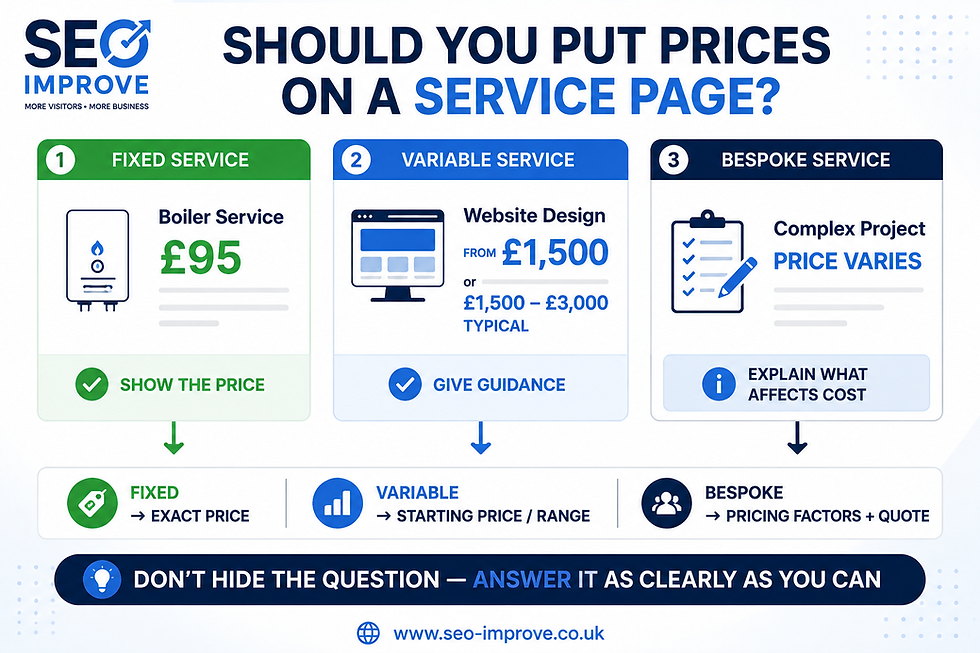
8. Pricing information where appropriate
You do not always need to publish an exact price.
But if customers naturally want to know what something costs, refusing to acknowledge pricing at all can create unnecessary uncertainty.
Depending on the service, you could provide:
fixed price
starting price
typical range
minimum charge
explanation of what affects the price
quote process
Pricing deserves more thought than simply deciding whether to show one number. Our guide to whether a service page should include prices explains what to publish when costs are fixed, variable or genuinely bespoke.
The objective is to answer the question as far as your business reasonably can.
9. Frequently asked questions
FAQs can be useful when they answer genuine buyer questions.
Examples might include:
How long does the work take?
Which areas do you cover?
Do I need to prepare anything?
What happens if the problem cannot be fixed?
Do you provide a guarantee?
Do not add 20 artificial questions simply to increase page length.
Five useful questions beat fifteen pointless ones.
The harder question is deciding which questions genuinely deserve a place on the page. See whether service pages should have FAQs for guidance on how many to include, which customer questions are useful and when FAQ content becomes unnecessary filler.
10. A clear next step
A service page ultimately needs to do something.
The visitor should not reach the bottom and wonder what happens now.
Use a clear call to action such as:
Request a Quote
Check Availability
Book a Consultation
Call About This Service
Request an SEO Review
The wording should match the service and the level of commitment expected from the visitor.
Longer pages may need to make that same next step available at several points rather than hiding it at the bottom. See how many calls to action a service page should have for a practical placement model.
You can see the wider content, structure and conversion checks included in what we check during an SEO review.
Should Every Section Be Long?
No.
Good service pages are not essays.
Some information works better as:
short paragraphs
bullet points
comparison tables
steps
FAQs
photographs with captions
testimonials
short explanatory boxes
A visitor should be able to scan the page and quickly find what matters to them.
That means good heading structure is often more important than simply adding more text.
A 900-word page divided into useful sections can feel easier to consume than a 500-word wall of text.
Write for scanning as well as reading.
How Long Should the Introduction Be?
Keep it short.
For most service pages, around two to four concise paragraphs is plenty before getting into the detail.
Someone landing from Google should not have to scroll through a company history before discovering whether you offer the service they searched for.
The opening should answer:
What is this?
Is it relevant to me?
Where is it available, if location matters?
Then move into the supporting detail.
Does a Local Service Page Need More Content?
Not simply because it targets a location.
Do not take a 700-word service page and add another 500 words of generic information about the town purely to make the page “local”.
Statements about local landmarks, population or the history of the town usually contribute very little to someone looking for a service.
Local information should be commercially useful.
For example:
areas actually covered
response times
local projects
local customer examples
relevant photographs
service-area limitations
locally relevant process information
Our guide to local SEO for small businesses covers the broader relationship between services, locations and local search visibility.
Can a 300-Word Service Page Rank?
It can.
There is no rule preventing it.
The more useful question is:
Can 300 words properly satisfy the person searching for this particular service?
For some simple services, perhaps.
For a major service where customers need significant explanation, trust and reassurance, probably not.
Do not treat a ranking page with 300 words as proof that every competitor should also use 300.
Search results depend on far more than page length.
The page's relevance, website, links, competition, local signals and other factors can all differ.
Copying the word count does not copy the reasons the page performs.
Is 2,000 Words Too Long for a Service Page?
Not automatically.
If the service is complex and the information is useful, a long page can be perfectly reasonable.
But 2,000 words creates a higher burden of proof.
Every section needs to justify its place.
If the page becomes repetitive halfway through, cut it.
A useful editing test is:
If I removed this section, would the potential customer lose information that might materially help them understand, trust or buy the service?
If the answer is no, you probably do not need it.
Should You Match the Word Count of Pages Already Ranking?
Look at competing pages, but do not blindly imitate them.
Competitor research can reveal:
questions customers expect answered
sections you may have overlooked
terminology used in the market
useful trust information
gaps you could answer better
But if the top three pages contain 1,200 words, that does not prove 1,200 is the secret.
Likewise, a competitor ranking with 450 words does not mean your page needs to stay under 500.
Study what the pages answer, not merely how many words they contain.
What If Your Service Page Is Already Too Thin?
Do not add random paragraphs.
Start by reviewing what is missing.
Ask:
Does the page clearly explain the service?
Does it explain who it is for?
Does it answer the major buyer questions?
Does it show why the business is credible?
Does it explain what happens next?
Does it contain a clear call to action?
If several of those are missing, adding the answers will naturally strengthen the page.
Thin content can also make it difficult for search engines to distinguish a service page from a stronger homepage. See why your homepage may rank instead of your service page for the other signals worth checking.
Our guide to why a small business website may not be showing on Google covers thin service content alongside other visibility problems.
What If the Page Is Already Very Long?
Do the opposite exercise.
Look for:
repeated arguments
generic introductions
irrelevant information
sections written for search engines rather than customers
multiple FAQs answering essentially the same question
unnecessary keyword repetition
information better suited to a separate blog article
Some content should not live on the service page.
For example, an electrician's service page might briefly answer:
How often does a landlord need an electrical inspection?
If that question deserves a detailed 1,500-word explanation, write a separate guide and link between the two.
That keeps the service page focused while allowing the supporting article to explore the subject properly.
This is one of the ways blog content can support commercially important pages rather than competing with them.
Service Page or Blog Post: Where Should Detailed Information Go?
This is an important distinction.
A service page should primarily help someone understand and consider buying the service.
A blog post can explore narrower informational questions in greater depth.
For example:
Service page:Boiler Installation
Supporting articles:
How much does a new boiler cost?
How long does boiler installation take?
When should a boiler be replaced?
Which type of boiler do I need?
The service page can answer those questions briefly and link to the detailed guides where useful.
The supporting guides can then link back to the service page.
That creates a much stronger relationship than trying to make one enormous page answer every possible question.
It also connects directly to the structure discussed in Should Every Service Have Its Own Page?.
Page Quality Matters More Than Page Length
A strong service page should be judged by what it achieves, not by the number in your word processor.
A good page should help the right visitor:
understand the service
↓
recognise that it matches their need
↓
trust the business
↓
understand the next step
↓
enquire
SEO and conversion should not be treated as completely separate jobs here.
A page may attract visitors but still be commercially weak if nobody feels confident enough to contact the business.
Our guide to why websites get visitors but no enquiries looks at that problem in more detail.
A Simple Service Page Length Test
Before publishing, stop looking at the word counter and ask these ten questions:
Is the service immediately clear?
Does the page explain who it is for?
Does it address the customer's main problem?
Does it explain what is included?
Does it explain how the process works?
Does it answer the main questions customers ask?
Does it contain enough relevant trust evidence?
Is location information clear where necessary?
Is the next step obvious?
Is there anything on the page that exists purely to make it longer?
If questions 1–9 are answered properly and question 10 is no, the page is probably long enough.
How Long Should a Service Page Be for SEO? The Bottom Line
There is no perfect service-page word count.
For many small business websites, 600–1,200 words is a useful working range for an important core service page, but it should never become a target you force every page to reach.
A straightforward service may need less.
A complex or expensive service may need considerably more.
The right length is:
enough information to completely explain the service, answer the important buyer questions, establish trust and make the next step clear — without adding filler merely to increase the word count.
Do not make an incomplete page longer.
Make it more useful.
Do not make a useful page longer simply because an SEO tool tells you another competitor has more words.
If you are unsure whether your existing service pages are too thin, too vague, overloaded or failing to match what customers are searching for, our small business SEO review assesses content quality alongside page structure, search intent, headings, internal links, trust and conversion. Your current service explicitly covers content quality and identifies pages where content is thin, vague or misaligned.
Request an SEO review and we will show you which pages are worth improving first.
Frequently Asked Questions
How long should a service page be for SEO?
There is no fixed SEO word count. For many small business service pages, 600–1,200 useful words is a reasonable working range, but the page should be as long as necessary to properly explain the service and answer the customer's important questions.
Is 500 words enough for a service page?
It can be. A simple service may be explained properly in 500 words. A more complex or expensive service may require considerably more information. Judge completeness rather than the number alone.
Do longer pages rank better on Google?
Not simply because they contain more words. Google explicitly advises against writing to a particular word count because you believe it has a preferred length.
Can a service page be too long?
Yes. A page becomes too long when additional sections are repetitive, irrelevant or exist primarily to increase the word count rather than help the customer.
What should I include on a service page?
A strong service page should usually explain what the service is, who it is for, the problem it solves, what is included, how the process works, relevant trust evidence, common questions and a clear next step.
Should FAQs count towards service page content?
FAQs are useful when they answer genuine customer questions. Do not add unnecessary questions merely to increase the length of the page.