Should Service Pages Have FAQs?
If you are wondering should service pages have FAQs, the answer for many small business websites is yes — when the questions help a potential customer understand the service, remove uncertainty or decide whether to enquire.
An FAQ section is not compulsory, though.
Adding ten or fifteen generic questions to every service page does not automatically improve SEO. In fact, FAQs can make a page worse when they repeat information already covered, introduce irrelevant topics or exist purely to add more keywords.
Useful service-page FAQs might answer questions such as:
How much does the service cost?
How long does it take?
Which areas do you cover?
What is included?
Do I need to prepare anything?
What happens after I enquire?
Is there a guarantee?
What happens if the problem cannot be fixed?
The better principle is:
Real customer question → useful answer → less uncertainty → clearer next step
If you are reviewing the wider content on the page, start with how long a service page should be for SEO.

Should Service Pages Have FAQs?
For many important service pages, yes.
But the FAQ section needs a genuine reason to exist.
Imagine someone looking for a boiler repair.
They already understand that you repair boilers. They can see that you work in Chester and they have read some customer reviews.
Before contacting you, however, they still want to know:
Do you charge a call-out fee?
How quickly can you attend?
Which boiler brands do you repair?
What happens if you cannot fix it?
Is the repair guaranteed?
Those are useful FAQs because they resolve genuine concerns.
Now compare them with:
What is boiler repair?
Why are boilers important?
What is a boiler?
Why should I choose a professional boiler company?
Those questions may make the page longer, but they probably add very little for somebody already considering a boiler-repair service.
The question is not whether your service page contains an FAQ section.
It is whether the FAQ section helps somebody make a better decision.
What Is the Purpose of FAQs on a Service Page?
A good service page should help somebody move through a decision:
I need this service
↓
I understand what this business provides
↓
I think they may be suitable
↓
My main concerns have been answered
↓
I am comfortable taking the next step
FAQs are particularly useful near the end of that process.
They give you somewhere to answer smaller but commercially important questions that do not necessarily deserve a large standalone section.
For example:
Do you work with Wix websites?
may only need a short answer.
Likewise:
Do you offer evening appointments?
could matter to the customer without needing several paragraphs of explanation.
FAQs work best when they complete the service page rather than dominate it.
FAQs Should Remove Customer Uncertainty
A customer rarely arrives on a service page asking only:
Do you provide this service?
They may also be wondering:
Can you help someone like me?
Do you work in my area?
How much will it cost?
What happens next?
How long does it take?
Is there a guarantee?
Am I committing to anything by enquiring?
A good FAQ section anticipates those concerns.
That is also why FAQs can support trust and conversion.
Our guide to what trust signals a small business website should have explains how clear pricing, reviews, process information and reassurance can make it easier for somebody to take the next step.
Do FAQs Help Service Page SEO?
They can help make a service page more useful and complete, but there is no automatic SEO benefit simply because the page contains FAQs.
Useful FAQs may add relevant information about:
pricing
service scope
locations
timescales
process
guarantees
eligibility
common concerns
For example:
Do You Repair Worcester Bosch Boilers?
Yes. We repair common faults on Worcester Bosch boilers alongside several other major domestic boiler manufacturers.
That answer is useful to a customer.
It also gives search engines more context about what the service covers.
The order matters:
Useful answer first.
Additional search context second.
Do not write FAQs primarily as places to insert extra keywords.
Do FAQs Automatically Make a Service Page Rank Better?
No.
A weak service page does not become strong because you add eight questions at the bottom.
Imagine a page that says:
We offer professional boiler repairs in Chester. Contact us today.
Then underneath it has FAQs such as:
What is boiler repair?
Why is boiler repair important?
What are the benefits of boiler repair?
Why choose a professional boiler company?
The underlying page is still weak.
It has not properly explained:
faults handled
boiler types
process
service area
experience
pricing
response expectations
proof
what happens next
Add the important service information first.
Use FAQs for supporting questions that remain unanswered.
How Many FAQs Should a Service Page Have?
There is no fixed number.
For many small business service pages, three to eight genuinely useful questions is a sensible starting point.
That is not a Google rule.
A simple service may only have three questions worth answering.
A complex or expensive service might reasonably need eight or ten.
The test is not:
Have we reached five FAQs yet?
The test is:
Is there another important customer question that still needs answering?
Stop when the useful questions stop.
Five relevant FAQs are better than fifteen questions invented simply to make the page look comprehensive.
Where Should FAQs Go on a Service Page?
For many service pages, FAQs work best towards the lower part of the page, after the visitor already understands the main service.
A sensible page structure might be:
Service proposition
What do you provide?
↓
Who the service is for
Who needs it?
↓
What is included
What does the customer receive?
↓
Process
How does it work?
↓
Reviews, examples or proof
Why should somebody trust you?
↓
Pricing or pricing guidance
What might it cost?
↓
FAQs
Resolve remaining questions.
↓
Final call to action
What should the customer do next?
Once somebody has had their remaining concerns answered, give them a clear next step.
See how many calls to action a service page should have for guidance on where those actions should appear.
Do FAQs Always Belong at the Bottom?
No.
Some information is too important to hide inside an FAQ section.
If price is one of the biggest buying questions, pricing may deserve its own visible section.
If where you work is commercially important, your service area may deserve its own section.
And information such as:
What is included in the service?
normally belongs in the main service content rather than being hidden in an accordion.
FAQs should handle remaining questions.
They should not become a dumping ground for important information that deserves greater prominence.
What Questions Should You Put in the FAQ Section?
Start with questions real customers actually ask.
Useful sources include:
customer emails
phone calls
sales conversations
quotation discussions
objections
questions asked immediately before booking
questions asked after receiving a price
Ask yourself:
What do customers repeatedly ask before they are comfortable saying yes?
Those questions should be near the top of your list.
Your real sales conversations are often a better FAQ source than a keyword tool.
Pricing Questions Often Make Good FAQs
Price is one of the most common customer concerns.
Examples include:
How Much Does the Service Cost?
Prices start from £95, with the final cost depending on the work required.
Do You Charge a Call-Out Fee?
Our standard call-out includes the initial inspection and diagnosis. Any additional work is explained before we proceed.
Is VAT Included?
Yes. All prices shown include VAT.
If pricing is a major part of the buying decision, however, do not rely solely on an FAQ.
Give pricing its own section as well.
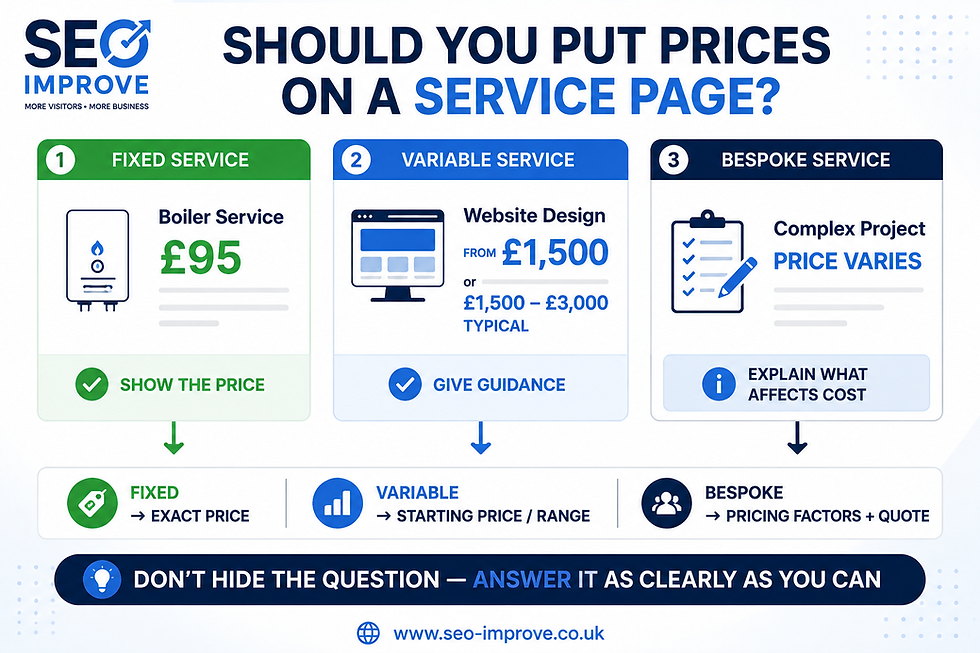
Our guide to whether you should put prices on a service page explains when exact prices, starting prices and ranges make sense.
Service-Area Questions Can Be Useful
Local service businesses may reasonably answer:
Which Areas Do You Cover?
For example:
We provide boiler servicing throughout Chester, Frodsham, Helsby and Ellesmere Port, with wider coverage available for planned installations.
But service-area information should not exist only in an FAQ if location is important to the sale.
Our guide to where you should list the areas you serve on your website explains how service pages, the homepage, contact page and dedicated service-area content can work together.
Process Questions Work Well
Customers often want to understand what actually happens.
Useful questions might include:
What Happens After I Request a Quote?
We review your details and contact you to confirm the requirements. If we can help, we explain the next step and provide pricing before work begins.
How Long Does the Work Take?
Most appointments take around 60–90 minutes, although more complex work can take longer.
Do I Need to Prepare Anything?
Please make sure we can access the boiler and, where possible, have details of any error code available.
These questions reduce uncertainty without requiring large additional sections.
Guarantee and Risk Questions Can Be Valuable
Potential customers often worry about what happens if the service does not go perfectly.
Useful questions might include:
Is the work guaranteed?
What happens if you cannot repair the fault?
What if I need to cancel?
What happens if additional work is required?
These can be especially important for:
repairs
building work
expensive services
professional services
complex projects
Answer them clearly.
Eligibility Questions Can Improve Enquiry Quality
Some services are not right for everyone.
Useful FAQs might include:
Do you work with ecommerce websites?
Can you review a Wix website?
Do you work with existing WordPress websites?
Is this suitable for a new business?
Do you work with residential and commercial customers?
Those questions can help potential customers establish whether the service fits before they contact you.
That can improve enquiry quality as well as reducing unnecessary uncertainty.
What Questions Should Not Be FAQs?
Do not turn normal page headings into questions simply so you can create an FAQ section.
For example:
Why Choose Us?
is normally better answered through:
reviews
evidence
case studies
qualifications
experience
guarantees
Likewise:
What Services Do You Offer?
may add little on a page dedicated to one particular service.
The FAQ format should not replace normal page structure.
Do Not Repeat the Whole Service Page in the FAQs
Suppose the main pricing section already says:
Boiler servicing costs £95.
Then the FAQ says:
How Much Does Boiler Servicing Cost?
Boiler servicing costs £95.
That may still help someone scanning the page, but if every FAQ simply repeats information from immediately above, the section is adding very little.
Look for questions that:
clarify
reassure
expand
qualify
resolve objections
rather than simply restating the page.
Should FAQ Answers Be Short?
Usually.
Most service-page FAQ answers only need one short paragraph.
For example:
How Long Does an SEO Review Take?
Most small business reviews are completed within five working days once we have the information needed. Larger or more complex websites may take longer, and we confirm this before starting.
That answers the question.
You do not need another 500 words.
If the question genuinely deserves a detailed explanation, consider creating a separate article.
When Should an FAQ Become a Separate Blog Post?
Some questions deserve more than a short answer.
For example, a boiler-installation page might contain:
How Much Does a New Boiler Cost?
with a short answer.
But if customers regularly search for detailed information about boiler costs, you could publish a separate article covering:
boiler types
installation complexity
property size
labour
controls
additional work
typical price ranges
The service page can answer the question briefly and link to the detailed guide.
The detailed article can then link back to the commercial service page.
That creates:
Service page
↓
Short answer
↓
Detailed guide
↓
Relevant service
This is usually better than forcing every possible topic onto one commercial page.
Should Every Service Page Have Different FAQs?
Where the services genuinely create different questions, yes.
A Boiler Repair page might answer:
What faults do you repair?
Do you offer emergency repairs?
What happens if the boiler cannot be fixed?
A Boiler Servicing page might answer:
How often should a boiler be serviced?
What does a boiler service include?
How long does a service take?
Those are different customer needs.
Copying exactly the same generic FAQ block onto every service page weakens that distinction.
Some questions can legitimately appear across several pages, such as:
Which areas do you cover?
But service-specific questions should reflect the service.
Do Not Use FAQs to Artificially Differentiate Similar Pages
There is another risk.
Suppose you have two service pages that are already extremely similar.
Rather than questioning whether both URLs are needed, you add different FAQs to each one to make them appear more unique.
That does not necessarily solve the underlying problem.
If two pages target essentially the same customer need and exist mainly for slight keyword variations, the website may have too many overlapping pages.
Read whether every service should have its own page before using FAQs to manufacture differences between weak pages.
Should FAQs Use Accordions?
They can.
Accordions can make a longer FAQ section easier to scan, especially on mobile.
If you only have three or four short questions, showing the answers openly may be simpler.
If you have eight or ten, an accordion can make the section easier to navigate.
Whichever layout you choose, make sure:
the questions are easy to identify
answers are easy to open
everything works properly on mobile
important information is not unnecessarily hidden
Use the presentation that makes the page easier for customers.
Do FAQs Need FAQ Schema?
Do not add FAQs because you expect a large FAQ rich result in Google.
Google substantially reduced FAQ rich results in 2023 and said they would generally be shown only for well-known, authoritative government and health websites.
For an ordinary small business website, the reason to add FAQs should be:
useful answers
better customer understanding
less uncertainty
a stronger service page
—not the hope of getting extra space in Google.
Can FAQs Help AI Search?
Clear question-and-answer formatting can make information easier to interpret because the question and answer are explicitly connected.
But that is still not a reason to manufacture dozens of questions.
A useful question such as:
Do you review Wix websites?
has value.
Twenty keyword variations of essentially the same question do not.
Write for the real information need.
Should Important Information Exist Only in FAQs?
No.
If your biggest customer concerns are:
What does it cost?
Where do you work?
What is included?
those subjects may deserve their own sections.
For example:
What Is Included
Pricing
Areas We Cover
Then use FAQs for smaller remaining questions.
An FAQ section should complete the service page.
It should not become the service page.
Do You Need a Separate FAQ Page as Well?
Possibly.
A website-wide FAQ page can answer broader business questions such as:
payment methods
cancellation policy
opening hours
general service areas
general booking process
But service-specific questions should normally be answered on the relevant service page as well.
Do not force somebody reading about Boiler Repair to leave that page and search through forty unrelated questions elsewhere.
Put important answers where they are most useful.
How Should You Write FAQ Answers?
Use a direct structure.
Ask one clear question.
Then:
Answer it immediately.
Add one or two sentences of useful context where needed.
Link to more detailed information only where it genuinely helps.
For example:
Do You Publish Prices?
Yes. Our standard small business SEO review starts from £99. Larger or more complex websites may require a wider review, and we confirm the price before starting. See our SEO review pricing for details.
Do not begin with several sentences of company marketing before eventually answering the question.
A Practical FAQ Example for a Local Service Business
A Boiler Repair page might use:
How Quickly Can You Attend a Boiler Repair?
Availability varies, but urgent appointments are prioritised where possible. Contact us with the fault and postcode and we will confirm the earliest available appointment.
Which Areas Do You Cover?
Boiler repairs are available throughout Chester, Frodsham, Helsby, Ellesmere Port and surrounding areas.
Is There a Call-Out Charge?
We explain the initial charge before confirming the appointment. Any additional repair work is discussed before we proceed.
Which Boiler Brands Do You Repair?
We work with many common domestic boiler brands. Send us the manufacturer and model when enquiring so we can confirm suitability.
What Happens If the Boiler Cannot Be Repaired?
We explain the problem and available options before recommending replacement or additional work.
Five questions.
Each answers a real buying concern.
No filler.
A Practical FAQ Example for a Professional Service
A Small Business Bookkeeping page might answer:
How Much Does Monthly Bookkeeping Cost?
What Records Do You Need From Me?
Can You Work With Xero or QuickBooks?
How Often Do I Need to Send My Records?
Can You Take Over From My Existing Bookkeeper?
Again, these questions relate directly to the service and buying decision.
A Simple Service-Page FAQ Test
Before publishing your FAQs, ask:
Do customers genuinely ask this?
If not, question why it exists.
Does the answer reduce uncertainty?
If not, it may be filler.
Is this information important enough to deserve its own section?
If yes, move it out of the FAQ.
Is the answer already repeated elsewhere?
If yes, decide whether repetition genuinely helps.
Does it relate specifically to this service?
If not, it may belong on a broader FAQ page.
Could the answer influence whether somebody enquires?
If yes, it probably deserves attention.
Is the answer clear and specific?
Remove vague marketing language.
Does the question deserve a whole article?
If yes, give a short answer and link to the detailed guide.
Should Service Pages Have FAQs? The Bottom Line
For many small business service pages, yes — a useful FAQ section is worth having.
But only if there are real questions to answer.
The strongest service-page FAQs usually address:
price
timescale
coverage
process
eligibility
guarantees
what is included
what happens next
There is no magic number.
Three useful questions may be enough.
Eight may be appropriate for a more complex service.
Twenty weak questions do not become valuable simply because there are more of them.
Use this principle:
Important customer question
↓
Clear answer
↓
Less uncertainty
↓
Easier decision
Do not add FAQs purely to increase page length.
Do not add them merely because you hope for a Google rich result.
Do not hide major buying information inside an accordion simply to make the page look tidy.
And do not copy the same generic FAQ block onto every service page.
Use FAQs to finish the job the rest of the service page has started:
help the right visitor understand the service, trust the business and know what to do next.
If you are still deciding what an important service page actually needs, work through our small business SEO checklist.
You can also see what we check during an SEO review for the wider relationship between service-page structure, content quality, search intent, trust and conversion.
Our small business SEO review identifies where important information is missing, where content has become filler and where unanswered questions may still be preventing enquiries.
Request an SEO review and we will show you which improvements are worth prioritising first.
Frequently Asked Questions
Should service pages have FAQs?
Yes, where customers have genuine questions that are not already answered clearly elsewhere on the page. FAQs are particularly useful for resolving smaller concerns about pricing, timescales, process, service areas, guarantees and what happens next.
How many FAQs should a service page have?
There is no fixed number. Around three to eight useful questions is a sensible starting point for many service pages, but stop when the genuine customer questions stop.
Do FAQs help SEO?
They can strengthen a page by adding useful and relevant information. There is no automatic SEO benefit simply from adding an FAQ section.
Where should FAQs go on a service page?
They often work well towards the lower part of the page after the main service explanation, process, proof and pricing, but before the final call to action.
Should pricing be included in an FAQ?
A short pricing question can be useful, but if cost is a major buying consideration, pricing usually deserves a dedicated visible section as well.
Should every service page use different FAQs?
Service-specific pages should normally answer questions relevant to that particular service. Some genuine business-wide questions may reasonably appear on several pages.
Should service pages use FAQ schema?
Do not add FAQs purely for FAQ rich results. Google no longer regularly shows FAQ rich results for ordinary small business websites. Add questions because they improve the content and customer experience.
Can an FAQ question become a separate blog post?
Yes. If a customer question deserves a detailed explanation, answer it briefly on the service page and link to a more detailed article where appropriate.