Should You Put Prices on a Service Page?
Updated: Aug 27
If you are wondering should a service page include prices, the answer for many small businesses is:
Yes — if you can give potential customers useful pricing information without misleading them.
That does not mean every service needs a fixed price.
Depending on what you sell, useful pricing information could be:
an exact price
a starting price
a typical price range
a minimum charge
example packages
an hourly or daily rate
an explanation of what affects the price
a clear quotation process
The mistake is assuming there are only two options:
publish one fixed price
or:
say nothing at all.
If somebody is seriously considering your service, cost is likely to be one of their questions.
Your service page should answer that question as clearly as your business reasonably can.
If you are reviewing what else belongs on the page, our guide to how long a service page should be for SEO explains the information customers typically need before they enquire.
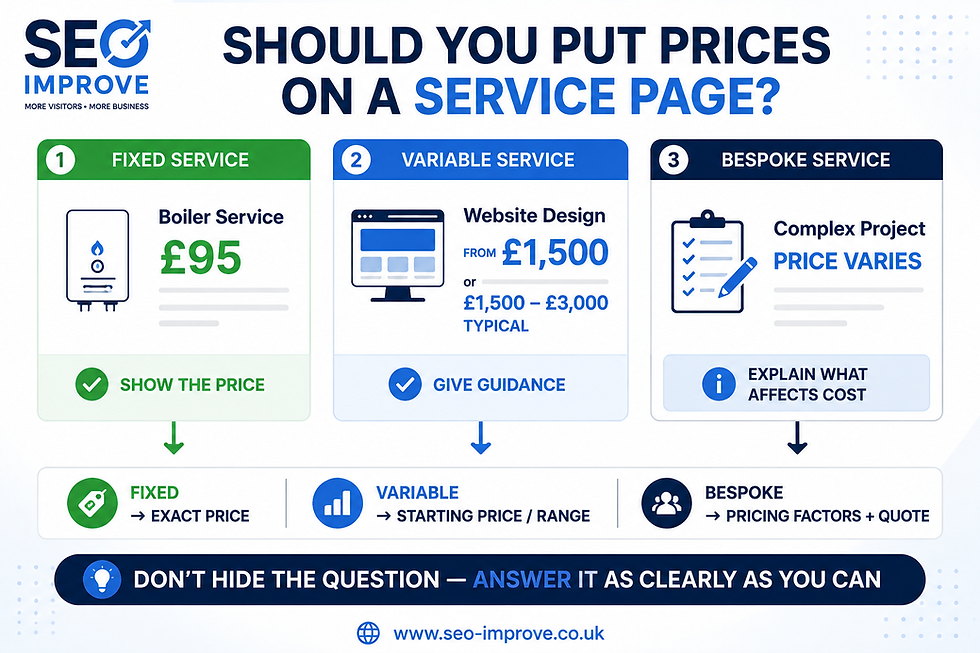
Should a Service Page Include Prices?
Usually, some form of pricing guidance is useful.
Imagine somebody is comparing three local businesses.
Business A says:
Contact us for a quote.
Business B says:
Boiler servicing from £95.
Business C says:
Boiler servicing from £95, including inspection, safety checks and a service report.
Any additional repair work is quoted separately before we proceed.
Which business has removed the most uncertainty?
Business C has not necessarily promised the cheapest service.
It has simply helped the customer understand:
roughly what they will pay
what that price includes
what could cost extra
what happens if additional work is needed
That is useful information.
Pricing transparency is not about being the cheapest.
It is about helping somebody make an informed decision.
Does Showing Prices on a Service Page Help SEO?
Do not put prices on a page because you think Google gives a ranking bonus for displaying them.
There is no simple rule that says:
page with price = higher ranking
The SEO value is more indirect.
Useful pricing information can make a service page more complete because it answers a genuine question customers have about the service.
It can also help the page naturally address searches such as:
boiler servicing cost
how much does bookkeeping cost
website design prices
or:
SEO review cost
But only where those searches genuinely relate to the service.
The reason to discuss price is not to insert another keyword.
It is to answer something a potential customer actually wants to know.
A useful service page should help somebody move from:
I have found this business
↓
I understand what they offer
↓
I understand roughly what it may cost
↓
I can decide whether it is worth enquiring
That is good content and good conversion design.
Why Do So Many Businesses Hide Their Prices?
Usually because they are worried about what will happen if people see them.
Common concerns include:
competitors will see our prices
somebody cheaper will undercut us
customers will think we are expensive
every job is different
we want people to call first
we need to explain the value before mentioning price
publishing prices will reduce enquiries
Some of those concerns can be legitimate.
But they need to be examined rather than simply accepted.
For example:
We don't show prices because customers might think we're expensive.
What happens instead?
The customer may assume you are expensive anyway.
Or they may simply return to Google and choose a competitor who gives them enough information to continue evaluating the service.
Hiding price does not remove the pricing question.
It just leaves the customer to answer it themselves.
Showing Prices May Reduce the Number of Enquiries
This is possible.
It can also be a good thing.
Suppose your service starts at £750.
Ten people visit the website.
Five have budgets below £250.
If your website hides the price, some of those five people may contact you.
You now have more enquiries.
But you do not necessarily have more potential customers.
You may simply have more conversations that cannot lead anywhere.
Now publish:
Projects start from £750.
Some unsuitable prospects may leave without contacting you.
Raw enquiry volume falls.
But the remaining enquiries may be better qualified.
That distinction matters.
The objective of a service page is not:
generate the highest possible number of form submissions
It is:
help appropriate potential customers move towards buying the service.
Fewer but better enquiries can be a stronger commercial outcome.
Pricing Can Help Customers Qualify Themselves
A good service page should help both sides decide whether there is a fit.
Imagine a small business needs a website redesign and expects it to cost £300.
The provider's projects actually start at £3,000.
Forcing that prospect to:
fill in a form
↓
wait for a response
↓
arrange a call
↓
explain the project
↓
finally discover the minimum price
has not necessarily helped either party.
A visible starting price could have established that immediately.
Likewise, somebody with a £5,000 budget might see:
Website projects from £3,000
and feel confident enough to enquire.
Price can therefore be a qualification signal as well as a sales detail.
Does Hiding Your Prices Encourage More People to Contact You?
Possibly.
But this is not automatically a win.
There is an old sales argument that says:
If somebody contacts us first, we can explain the value before revealing the price.
That can work for some:
complex B2B services
consultative sales
highly bespoke projects
expensive purchases
services requiring detailed scoping
But it can also introduce unnecessary friction for straightforward services.
Consider a customer looking for:
dog grooming
boiler servicing
passport photographs
or:
a one-off SEO review
They may simply want to know:
What does it cost?
Making them contact you to obtain information you already know can feel less convenient rather than more persuasive.
The right decision depends on the service.
When Should You Show an Exact Price?
An exact price works best when the service is standardised.
For example:
Boiler Service — £95
Initial Consultation — £75
SEO Review — £99
Passport Photographs — £15
If most customers receive essentially the same service for the same price, publishing the price is straightforward.
But make sure the customer understands what the price actually includes.
A naked number can create more questions.
Instead of:
SEO Review — £99
you might say:
SEO Review from £99
Includes review of your key pages, SEO settings, content clarity, local signals, trust and conversion issues, plus a prioritised action plan.
The price now has context.
SEO Improve uses this approach on our SEO review pricing page: the standard review starts from £99, while larger or more complex websites may require a larger quote.
When Should You Use a Starting Price?
Starting prices work well where there is a genuine minimum but final cost varies.
For example:
Garden design from £500
Website design from £1,500
Wedding photography from £1,200
SEO reviews from £99
This tells the visitor:
This is approximately where the relationship starts.
It filters people whose budget is nowhere close while leaving room for legitimate variation.
But be careful with misleading starting prices.
If virtually nobody can realistically buy the service for the headline amount, the starting price is not very useful.
For example:
Websites from £499
when a realistic customer almost always pays £2,500+ can create disappointment rather than trust.
Your starting price should describe a genuine entry point.
When Should You Show a Price Range?
A range works well where jobs vary but normally fall within predictable boundaries.
For example:
Most boiler repairs cost between £120 and £350, depending on the fault and parts required.
or:
Typical bookkeeping packages range from £150–£400 per month depending on transaction volume and the support required.
That is far more informative than:
Contact us for pricing.
A useful range tells somebody:
the approximate scale of the purchase
whether it fits their budget
why the final figure might vary
The explanation is just as important as the numbers.
What If Every Job Really Is Different?
Then say so.
But go further than:
Contact us for a bespoke quotation.
Explain what determines the quotation.
For example:
Building-project costs vary depending on the size of the property, specification, materials, structural requirements and access. We provide a written quotation once we understand the work required.
Or:
SEO review pricing depends mainly on the size and complexity of the website. Typical small business sites start from £99, while ecommerce, multi-location or larger sites may require a broader review.
The customer may not have an exact figure.
But they now understand how the figure is determined.
That reduces uncertainty.
What Pricing Information Can You Show Without Publishing a Fixed Price?
If a fixed price is not realistic, consider whether you can provide any of these:
Starting price
From £750
Useful where there is a genuine minimum.
Typical range
Most projects cost £1,500–£3,000
Useful where the majority of customers fall within a predictable band.
Minimum charge
Minimum call-out charge £85
Useful where small jobs have a clear floor.
Hourly or daily rate
Consultancy £125 per hour
Useful where time is the main pricing mechanism.
Packages
Basic — £250
Standard — £450
Premium — £750
Useful where the service can be productised.
Example projects
Typical five-page small business website: £1,500–£2,500
Useful where a concrete example is easier to understand than abstract pricing.
Pricing factors
Final price depends on floor area, materials and site access.
Useful where cost genuinely varies.
Quote process
Send us your requirements and we will provide a written quote before any work begins.
Useful where no sensible figure can be given before scoping.
Most service businesses can provide something more useful than complete silence.
Should You Put "Contact Us for a Quote" on a Service Page?
Yes, where quoting is genuinely necessary.
The weak version is:
Contact us for a quote.
with no explanation whatsoever.
A stronger version is:
Every extension project is different, so we quote individually. Cost is mainly affected by size, specification, structural requirements and access. Send us your plans or project details and we'll arrange the next step.
Now the visitor understands:
why there is no fixed price
what affects it
and:
what they need to do next.
The phrase:
contact us for a quote
is not the problem.
The absence of useful information around it is.
Where Should Prices Go on a Service Page?
Do not automatically hide pricing at the very bottom.
The right position depends on how much context somebody needs before the figure makes sense.
For a simple service, price can appear quite high on the page.
For example:
Boiler Servicing in Chester
Annual boiler servicing from £95.
BOOK A SERVICE
Simple.
For a more complex service, a sensible structure might be:
Service proposition
Explain what the service does.
↓
Who it is for
Help someone establish relevance.
↓
What is included
Explain what they receive.
↓
Process
Explain how it works.
↓
Reviews / examples / proof
Build confidence.
↓
Pricing or pricing guidance
Explain the likely investment.
↓
FAQs
Resolve remaining questions.
↓
Call to action
Make the next step obvious.
Pricing may be one of those questions, but FAQs should not become a place to hide information that deserves greater prominence. See whether service pages should have FAQs for guidance on what belongs in the FAQ section and what should remain visible in the main service content.
Our guide to how many calls to action a service page should have looks at how those decision points can be structured without filling the page with competing buttons.
Should Price Appear Near Reviews and Testimonials?
Often, yes.
Price rarely exists in isolation.
Somebody looking at a £2,000 service is also asking:
Is this worth £2,000?
That means evidence becomes particularly important around pricing.
Useful supporting evidence might include:
relevant customer reviews
examples of completed work
case studies
qualifications
guarantees
explanation of what is included
before-and-after examples
clear process
For example:
Website Review — £250
means relatively little by itself.
Compare it with:
Website Review — £250
Includes a manual review of your key pages, written recommendations, a prioritised action plan and a follow-up discussion.
★★★★★
“Instead of another automated score, we knew exactly which pages to fix first.”
The customer can now assess both:
price
and:
value.
This is why pricing belongs within the wider trust discussion. See what trust signals a small business website should have.
Pricing Is a Trust Signal — But Only When It Is Clear
Transparency can help build trust.
Confusing pricing can do the opposite.
Watch for:
prices that exclude unavoidable charges without making that obvious
outdated prices
unclear VAT treatment
"from" prices that almost nobody receives
packages where inclusions are impossible to understand
hidden compulsory extras
contradictory prices on different pages
a pricing page that still refuses to give any useful pricing information
If you publish pricing, maintain it.
An old price that changes as soon as somebody enquires can damage confidence more than having no figure at all.
Should You Create a Separate Pricing Page?
Sometimes.
A dedicated pricing page makes sense when:
you have several packages
pricing needs detailed explanation
customers frequently compare options
several service pages share the same pricing model
price is a major decision factor
you want one central place to maintain pricing information
But a separate pricing page does not mean your service pages should say nothing about cost.
A service page might say:
Bookkeeping packages start from £150 per month. See our pricing for package details and what is included.
That gives enough context without duplicating the entire pricing table.
Think of the relationship as:
Service page
What is the service?
Who is it for?
What does it include?
What does it broadly cost?
↓
Pricing page
Detailed options, ranges or packages.
SEO Improve uses that model: the small business SEO review explains the service and identifies the £99 starting point, while the SEO review pricing page provides greater detail about what is included and when a larger review may be required.
Will Competitors Use Your Published Prices Against You?
They might look at them.
That does not automatically make hiding prices sensible.
Competitors can usually establish approximate market pricing already.
The more useful question is:
Does publishing this information help our customers make a better decision?
If the answer is yes, do not withhold information purely because a competitor might read the page.
Competing entirely on being £10 cheaper is a weak position anyway.
Your service page should explain why the customer should choose you through:
relevant experience
scope
process
proof
service quality
convenience
specialisation
guarantees where relevant
clear expectations
Price is one part of the decision.
It should not have to carry the entire sale.
What If Your Prices Are Higher Than Competitors?
Then your page needs to explain why.
Hiding the price does not solve a weak value proposition.
Suppose:
Competitor A charges £500.
You charge £900.
If your website simply says:
Professional service — £900
the visitor may struggle to see the difference.
But perhaps your service includes:
an initial consultation
more comprehensive work
higher-quality materials
faster turnaround
ongoing support
stronger guarantees
specialist expertise
Explain that.
Higher prices are easier to understand when the difference in value is also visible.
That is another reason service pages need sufficient depth rather than just a heading, short paragraph and contact form.
Can Publishing Prices Improve Enquiry Quality?
Often, yes.
Price helps people self-select.
Someone substantially below your budget can recognise that early.
Someone comfortable with your pricing can enquire with greater confidence.
That can mean fewer conversations beginning with:
How much is it?
and more beginning with:
I'd like to discuss the service.
That is a meaningful improvement.
If your website already receives traffic but generates very few useful leads, pricing may be one of several conversion issues worth investigating. See why your website gets visitors but no enquiries for the wider diagnosis.
Can Publishing Prices Reduce Enquiries?
Yes.
Do not pretend otherwise.
But distinguish between:
lost potential customers
and:
filtered unsuitable enquiries.
If somebody sees:
Projects from £2,000
and leaves because their maximum budget is £300, publishing the price has not necessarily cost you a £2,000 customer.
It may simply have prevented an unproductive enquiry.
More form submissions is not automatically better.
Measure whether pricing helps produce:
better-fit enquiries
higher enquiry-to-sale rates
fewer price-only conversations
shorter qualification calls
clearer customer expectations
Those are commercially more useful measures than raw enquiry volume.
How Much Pricing Information Should a Service Page Include?
Enough to answer the customer without overwhelming the main service explanation.
For a straightforward service, that may be:
Boiler Service — £95
For a more variable service:
Bathroom installations typically range from £6,000–£12,000 depending on size, specification and structural work.
For a bespoke service:
Projects are quoted individually. Most clients invest from £3,000, with final pricing based on scope, complexity and timescale.
You do not need a twenty-row pricing table on every service page.
The objective is clarity.
What If You Have Several Service Packages?
Service packages can work well when customers genuinely understand the difference.
For example:
Essential
£99
Basic review of core pages.
Standard
£249
Broader review plus recommendations.
Advanced
£499
More extensive analysis and implementation planning.
The important part is making the distinction meaningful.
Do not create:
Bronze
Silver
Gold
with vague features purely because three pricing columns look good in a website template.
Customers need to understand:
Which option is for me?
If they cannot, packaging has added complexity rather than removing it.
Should Blog Posts Discuss Service Pricing Too?
Yes, when people genuinely search for detailed pricing information.
Imagine your service page says:
Boiler replacement typically costs £X–£Y depending on boiler type, property size and installation requirements.
A supporting blog article could go deeper:
How Much Does a New Boiler Cost?
The article might explain:
boiler type
property size
installation complexity
controls
labour
additional work
Then link naturally back to:
Boiler Installation
This lets the service page remain commercially focused while the article answers a narrower informational question in greater depth.
That is exactly how supporting blog content should work: answer the question, then connect the reader to the relevant service when useful.
A Simple Service-Page Pricing Test
Open your most important service page and answer these questions:
1. Does the page mention price at all?
If no, ask why.
2. Could you publish an exact price?
If yes, consider doing so.
3. If not, could you publish a starting price?
For example:
from £99
4. Could you provide a realistic range?
For example:
most projects cost £1,500–£3,000
5. Could you explain what changes the price?
If cost depends on:
scope
size
materials
complexity
location
timescale
or:
volume
say so.
6. Does the page explain what is included?
A number means little without context.
7. Is the pricing current?
Outdated prices create distrust.
8. Is the next step clear?
Tell the customer how to:
book
request a quote
check availability
or:
discuss the service.
If you can answer all eight clearly, the pricing section is probably doing its job.
What Should You Avoid When Adding Prices?
Hiding everything behind "contact us"
Do not create unnecessary friction where useful guidance is possible.
Publishing a misleading "from" price
The advertised starting point should be genuinely achievable.
Giving a number without explaining what is included
Price needs context.
Turning the whole service page into a price list
The customer still needs to understand the service and trust the business.
Copying competitors' pricing structure
Their business model may not be yours.
Competing purely on being cheapest
A race to the bottom is not a website strategy.
Forgetting to update prices
If the website says £99 and the customer is immediately told £149, confidence drops.
Assuming hidden prices automatically create conversations
Some visitors will call.
Others will leave.
You do not know which happened if you never test the assumption.
Should You Put Prices on a Service Page? The Bottom Line
For many small businesses:
yes, you should provide useful pricing information where you reasonably can.
That does not mean every service requires one fixed number.
Use the level of detail that matches the service:
Standard service
→ exact price
Variable service
→ starting price or typical range
Highly bespoke service
→ explain what affects cost and how quotations work
The goal is not:
show prices because SEO says so.
The goal is:
reduce unnecessary uncertainty.
A good service page should help someone understand:
What do you provide?
Is it relevant to me?
What is included?
Why should I trust you?
What might it cost?
What happens next?
If price is an obvious part of that buying decision and your page deliberately refuses to address it, you may be leaving an important question unanswered.
Pricing is only one part of a strong service page.
Reviews, relevant proof, clear calls to action, useful content and an easy enquiry route all matter too.
You can see what we check during an SEO review for the wider relationship between service content, trust, internal links and conversion.
If you are unsure whether your service pages give potential customers enough information to confidently enquire, our small business SEO review reviews your important pages and shows where content, trust or conversion information is missing.
Request an SEO review and we will show you which improvements are worth prioritising first.
Frequently Asked Questions
Should a service page include prices?
Usually, some pricing information is helpful if you can provide it accurately. That might be a fixed price, starting price, typical range, minimum charge or explanation of what affects the final quote.
Does showing prices on a website help SEO?
There is no simple ranking advantage for publishing a price. The benefit is that useful pricing information can make a service page more complete, answer genuine customer questions and naturally address relevant cost-related searches.
What if every customer pays a different price?
Explain why. Give a realistic starting point or typical range where possible, and describe the main factors that affect the final quotation.
Should I use "prices from" on my service page?
Yes, where the starting price represents a genuine entry point. Avoid artificially low "from" prices that almost no customer can realistically receive.
Will showing my prices reduce enquiries?
It may reduce some enquiries, particularly from people whose budgets do not match your service. That is not necessarily negative if the enquiries you receive become better qualified.
Should I have a separate pricing page?
A separate pricing page can be useful for businesses with multiple packages or complex pricing. Your service pages should still normally provide enough pricing context that visitors do not have to leave the page just to understand the likely cost.
Where should pricing appear on a service page?
Place it after enough information has been given for the customer to understand what they are buying. For simple fixed-price services that may be near the top. For complex services it may sit after the scope, process and proof sections.
Is "contact us for a quote" enough?
Sometimes a quotation is necessary, but explain why the price varies, what factors determine it and what happens after the customer requests a quote. Complete pricing silence is often less useful.
Should I show prices if my competitors do not?
Make the decision based on what helps your customers rather than simply copying competitors. Clear pricing can differentiate a business, but it needs to be presented alongside enough information to communicate value.


