Local SEO for Small Businesses: How to Help More Local Customers Find You
Updated: 7 days ago
If you run a small business, local SEO is one of the most practical ways to get more enquiries from people already searching for what you offer.
You are not trying to rank across the whole country. You are trying to show up when someone nearby searches for a service like yours and is ready to take action.
That might be:
“plumber near me”
“accountant in Chester”
“wedding photographer Wirral”
“SEO review for small business”
“roof repair Runcorn”
The problem is that many small business websites do not give Google enough clear evidence about who they help, what they do, where they work, and why they can be trusted.
One warning sign is when the website appears for the company name but not searches combining the service and location. See why a website can rank for its business name but not its services for the wider diagnosis.
Local SEO fixes that.
Local search is only one part of the picture. Our guide to the importance of SEO for small businesses explains how search visibility, trust and enquiries work together.
What Is Local SEO?
Local SEO is the process of improving your website and wider online presence so your business is more likely to appear in local search results.
That includes your website, Google Business Profile, reviews, location signals, service pages, contact details, local content, and the overall trust signals attached to your business.
Good local SEO helps Google understand three things:
What your business does
Where your business operates
Why your business is credible enough to show to local customers
If those signals are weak, unclear, or inconsistent, your competitors may appear ahead of you even if your service is better.
How Do I Improve Local SEO for a Small Business?
Start with clarity. Most small business websites fail because they are too vague.
Your website should make it obvious what you do, where you do it, and who you help within the first few seconds.
A strong local SEO foundation usually includes:
A clear homepage that explains your main service and target area
Dedicated service pages for your most important offers
Consistent business name, address, and phone number
A well-optimised Google Business Profile
Local reviews and testimonials
Location references written naturally into the copy
Helpful content that answers real customer questions
Internal links between related pages and blog posts
Clear calls to action on every important page
If your service area is currently mentioned only once or you are unsure which pages should contain location information, see where to list the areas you serve on your website. It explains how the homepage, service pages, contact page and location content should reinforce one another without repeating the same town list everywhere.
Do not start by chasing complicated SEO tricks. Fix the basics first. Google needs clear evidence, customers need confidence, and your website has to serve both. It also helps to understand the difference between a website audit and an SEO review before deciding what type of help you need.
Should I Add Town Names to My Website?
Yes, but not in a spammy way.
Adding town names to your website can help with local SEO, but only when it is useful, accurate, and natural. Listing every town in a huge block of text at the bottom of a page looks lazy and does not create a strong user experience.
A better approach is to mention locations where they make sense.
For example, instead of writing:
“We offer SEO services in Liverpool, Wirral, Chester, Runcorn, Warrington, St Helens, Ellesmere Port, Widnes, Southport and nearby areas.”
A stronger version would be:
“We help small businesses across Cheshire, Merseyside, Wirral and surrounding areas improve how they appear on Google, understand what is holding their website back, and identify the changes most likely to increase enquiries.”
That reads naturally, gives Google useful location context, and does not make the page look like it was written only for search engines.
If a town or area is commercially important to your business, it may deserve its own page.
If it is only a minor service area, a natural mention may be enough.
But where should those location references actually appear? Our guide to where you should list the areas you serve on your website explains how to use your homepage, service pages, contact page, footer and dedicated Areas We Cover content without repeating the same town list everywhere.
The difficult part is deciding where that line sits. Our guide to whether you should create a separate page for every town you serve explains when a location page has enough commercial value and useful local content to justify its own URL.
What Local Trust Signals Matter?
Local SEO is not just about keywords. Trust matters.
Google wants to show businesses that look real, relevant, and reliable. Customers want the same thing.
Important local trust signals include:
A complete Google Business Profile
Consistent contact details across your website and online listings
Real reviews from customers
Testimonials that mention the service provided
Clear service areas
A proper contact page
Local case studies or examples of work
Photos of your work, premises, team, or process where appropriate
Business policies, terms, privacy details, and FAQs
Clear signs that the website is maintained and up to date
Small businesses often underestimate this. A website can have decent keywords and still fail because it does not feel credible enough.
If your website looks thin, outdated, vague, or unsupported by proof, visitors may still leave without enquiring.
For a wider review of titles, headings, content, internal links, trust signals and calls to action, work through the small business SEO checklist.
How Do I Align My Website With Google Business Profile?
Your website and Google Business Profile should support each other.
They should not feel like two separate versions of your business.
Make sure the following details match:
Business name
Phone number
Address or service area
Website URL
Main business category
Opening hours
Services offered
Description of what you do
Locations served
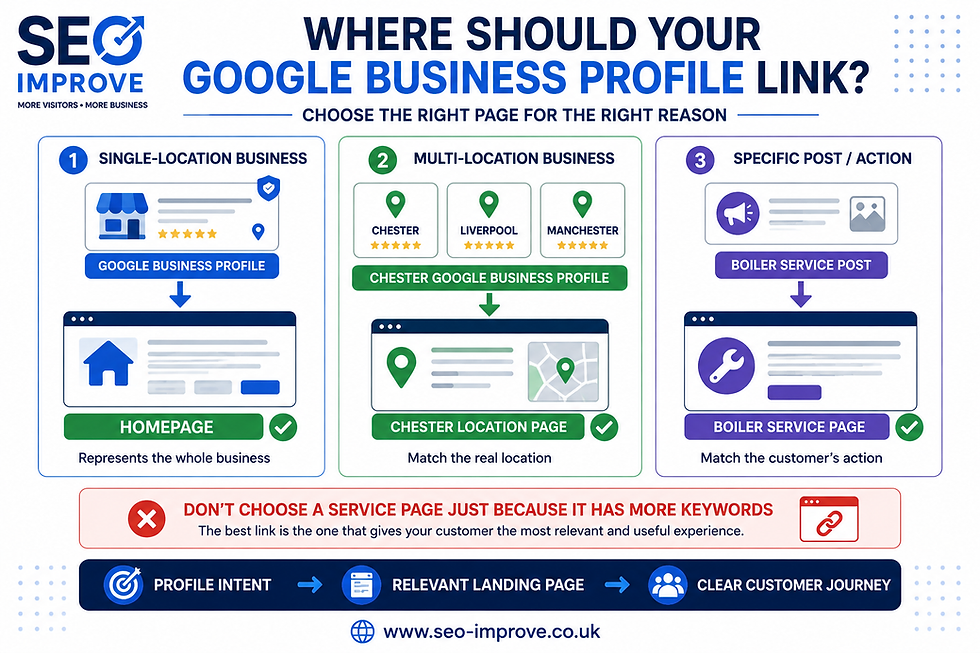
The website URL itself also deserves some thought. For most single-location businesses the homepage is the natural destination, but there are exceptions. See whether your Google Business Profile should link to your homepage or a service page for the differences between homepage, service-page and location-page links.
Your website should also reinforce the services listed on your Google Business Profile.
For example, if your Google Business Profile says you offer SEO reviews, website audits, local SEO support, and Google visibility improvements, your website should have clear pages or sections explaining those services.
If your profile says one thing and your website says another, you create confusion.
Confusion weakens trust.
A good local SEO setup makes the connection obvious. Google should be able to look at your profile, website, pages, reviews, and content and see the same story repeated clearly.
How Do Service Pages Support Local SEO?
If you offer several important services, hiding them all on one general Services page can make it harder for customers and search engines to understand what you provide.
A dedicated page often makes sense when a service has its own customer demand, search intent and enough useful information to justify a focused page. That does not mean creating a separate page for every small variation of what you do.
Read our guide to whether every service should have its own page for a practical way to decide which services deserve separate pages.
What Should I Fix First for Local SEO?
Fix the things that affect clarity, trust, and conversion first.
Do not waste time obsessing over tiny technical details while your main pages are still unclear.
The best starting order is usually:
Make your homepage clear
Improve your Google Business Profile
Create or strengthen your main service pages
Add clear location signals
Check your contact details are consistent
Add reviews, testimonials, and proof
Improve internal links
Fix missing or weak title tags and meta descriptions
Add helpful FAQs
Review what competitors are doing better than you
This order matters.
There is no point adding more blog posts if your main service page does not explain the offer properly. There is no point chasing backlinks if your Google Business Profile is half-finished. There is no point adding town names everywhere if your website does not clearly say what you do.
Local SEO works best when the foundations are strong.
If the wider problem is that the website has very little search visibility, see why your small business website may not be showing on Google before assuming the problem is purely local SEO.
The Local SEO Mistake Many Small Businesses Make
Many small businesses treat local SEO as a one-off task.
They add a few keywords, update a Google profile, maybe write a blog post, and then assume the job is done.
That is not enough.
Local SEO is about building a consistent pattern of evidence over time.
Your website, Google Business Profile, reviews, service pages, blog posts, internal links, and contact details should all point in the same direction.
That consistency may increasingly matter outside traditional local search too. See Will Customers Find Your Business Through AI? for how AI assistants may combine first-party business facts with third-party evidence when answering customer questions.
Google is looking for confidence. Customers are looking for confidence. If your online presence feels inconsistent or incomplete, you make both of them work harder.
And when people have to work harder to understand your business, they usually leave.
A Simple Local SEO Checklist for Small Businesses
Use this checklist as a starting point:
Does your homepage clearly explain what you do and where you work?
Does each important service have its own page?
Are your town, region, or service area references natural and accurate?
Does your Google Business Profile match your website?
Are your phone number, address, and business name consistent?
Do you have reviews or testimonials visible?
Do your title tags and meta descriptions include local search intent where appropriate?
Do your pages link to related services and helpful blog posts?
Is there a clear call to action on every important page?
Can a visitor understand your offer within five seconds?
Reviews are only one form of evidence. See what trust signals a small business website should have for the wider set of signals that can reassure both local and non-local customers.
If the answer to several of these is no, your local SEO is probably weaker than it should be.
Final Thought: Local SEO Is About Evidence
Local SEO is not about stuffing town names onto a page and hoping for the best.
It is about giving Google and potential customers enough evidence to trust your business.
Your website should clearly show:
What you do
Where you do it
Who you help
Why you are credible
What the customer should do next
For most small businesses, the quickest wins come from improving the core pages, aligning the website with Google Business Profile, adding stronger trust signals, and making the service offer easier to understand.
Before paying for ongoing SEO, it is also worth understanding what an SEO review should include and how it differs from a broad automated audit.
Related guidance and next steps
Local SEO problems rarely exist in isolation. They are often connected to weak page titles, unclear service pages, poor trust signals or conversion problems.
If local visibility is your main concern, our Local SEO Review examines your website, Google Business Profile, reviews, service areas and local competitors together, then gives you a prioritised action plan showing what should be fixed first.
See what we check during an SEO review, view an example SEO review report, or check the current SEO review pricing. When you are ready, you can request an SEO review of your website.