Why Is My Homepage Ranking Instead of My Service Page?
Updated: Sep 12
If you are asking why is my homepage ranking instead of my service page, Google may simply be receiving stronger signals from your homepage than from the page you actually want it to show.
That does not necessarily mean the service page is broken.
It can happen because your homepage has stronger internal links, more external links, clearer relevance, better-established authority, or because the service page itself does not give search engines enough reason to treat it as the best result.
For example, you may have a dedicated Boiler Repair page but find that your homepage appears when somebody searches for boiler repair instead.
The solution is not usually to remove every mention of boiler repair from your homepage.
If you are seeing more than one URL appear for the same searches and are not yet sure whether that represents genuine competition, first check whether the two pages are actually competing for the same keyword. Two pages mentioning the same service is not, by itself, evidence of a problem.
The solution is to make the relationship clearer:
Homepage = who you are and what you broadly offer
Service page = the strongest and most useful page about that specific service
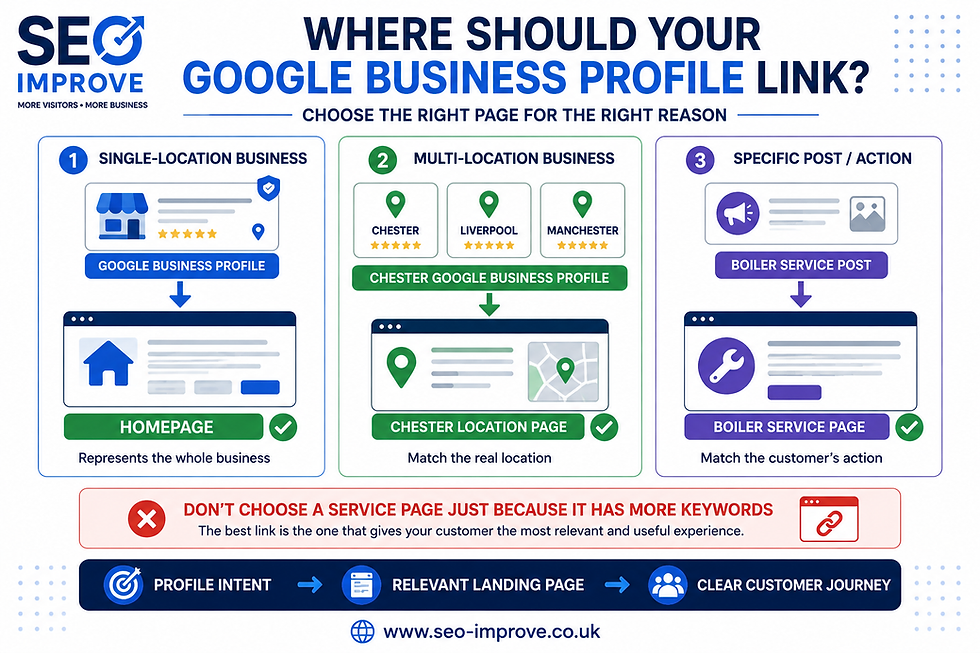
That distinction also matters outside the website. If you are deciding which URL to use as the main website destination on your Google profile, see whether Google Business Profile should link to your homepage or a service page. The correct destination is not automatically whichever page contains the most specific keyword.
A homepage outranking a service page is only one version of a wider problem. A homepage outranking a service page is only one version of a wider problem. If no page is appearing meaningfully for your service searches and the website mainly ranks when somebody searches for the company name, see why your website ranks for your business name but not its services. If Google is choosing a blog post, location page or another service page instead, see why Google may be ranking the wrong page on your website.
If Google is choosing a blog post, location page or another service page instead, see why Google may be ranking the wrong page on your website.
Here are the main reasons Google may be choosing the homepage instead.

Why Is My Homepage Ranking Instead of My Service Page?
Search engines do not simply rank whichever page you would prefer them to use.
They try to identify which page appears to be the most useful and relevant result for the search.
If your homepage consistently ranks for a service-specific search, it can indicate that Google currently has more confidence in the homepage for that topic.
That can happen for several reasons.
Your homepage may be stronger overall
Homepages commonly receive more links than internal service pages.
They are often linked from:
every page through the main navigation
the website logo
footers
business directories
social profiles
suppliers
partners
local organisations
other websites mentioning the business
That means the homepage may naturally accumulate more authority than an individual service page.
If the service page itself is relatively weak, the homepage can win even though it is less specific.
Your homepage may be optimised too heavily for the service
Imagine a plumbing company's homepage contains:
Page title:Boiler Repair Chester | Emergency Boiler Repairs | Smith Plumbing
H1:Boiler Repair Specialists in Chester
and most of the homepage content discusses boiler repairs.
The business then creates:
/boiler-repair
with:
Page title:Boiler Repairs | Smith Plumbing
H1:Our Boiler Repair Services
It is not difficult to see why the homepage might continue ranking.
The homepage may actually be sending clearer signals about boiler repair than the dedicated boiler repair page.
This does not mean the homepage should stop mentioning the service.
It means the two pages need different jobs.
Your Service Page May Be Too Thin
This is one of the first things I would check.
A dedicated URL is not automatically a strong service page.
Something like this is unlikely to establish much distinction:
Boiler Repair
We provide professional boiler repair services throughout Chester. Contact our experienced team today for reliable boiler repairs.
That page technically exists.
But it says very little that the homepage could not already say.
A genuinely useful service page could instead explain:
what boiler problems you repair
which boiler types or brands you work with
whether emergency repairs are available
how the diagnosis process works
what happens when a repair is not economical
areas you cover
relevant qualifications
guarantees
pricing or call-out information
frequently asked questions
how to arrange a repair
The service page then becomes demonstrably more useful for someone specifically looking for boiler repair.
If your page is currently very short, see How Long Should a Service Page Be for SEO?.
The objective is not to hit an arbitrary word count. It is to make the dedicated page genuinely better at answering the service-specific search.
Your Page Title May Not Clearly Differentiate the Service Page
Compare these two page titles:
Homepage
Smith Plumbing | Plumbers in Chester
Service page
Boiler Repair in Chester | Smith Plumbing
The relationship is obvious.
Now compare:
Homepage
Boiler Repair Chester | Smith Plumbing
Service page
Our Services | Smith Plumbing
The wrong page is much more likely to appear relevant.
Important service pages should normally have titles that clearly describe their specific subject.
The homepage can target the broader business proposition.
You do not need to completely remove important services from the homepage title simply because they have dedicated pages, but avoid making the homepage look like the strongest dedicated page for every individual service.
Your title and main heading do not have to use identical wording, but they should clearly describe the same page. See should your page title and H1 be the same? for practical examples of when matching and different wording both make sense.
Your H1 and Page Content May Be Too Generic
The same problem occurs inside the page.
A weak service page might have:
H1:Our Services
followed by generic copy.
A much clearer page would use something like:
H1:Boiler Repair in Chester
The supporting headings can then cover subjects such as:
Common Boiler Problems We Repair
How Our Boiler Repair Service Works
Emergency Boiler Repairs
Boiler Repair Costs
Areas We Cover
Frequently Asked Questions
The important point is not mechanically adding keywords to headings.
It is making the page unmistakably about the service.
If Google has to choose between a broad homepage containing substantial information about the service and a vague dedicated page, the homepage may continue winning.
Your Internal Links May Favour the Homepage
Internal links are particularly important here.
Imagine you publish five useful articles about boiler problems.
Every article ends with:
Contact [Smith Plumbing] for help with your boiler.
and links Smith Plumbing to the homepage.
Meanwhile, none of those articles links to the dedicated boiler repair page.
You are repeatedly reinforcing the homepage.
A better contextual link would be:
If the fault needs professional attention, see our boiler repair service.
with boiler repair service linking directly to the boiler repair page.
That tells both visitors and search engines where the detailed commercial information about that service lives.
Your internal-link structure should reinforce the role of the service page.
If most related content links to the homepage while the dedicated service page receives little support, the internal structure may be reinforcing the wrong destination. See how many internal links a page should have before adding links indiscriminately.
Check How the Homepage Links to the Service
Your homepage should not merely say:
We offer boiler repairs, servicing, installations, bathrooms, heating and plumbing.
with everything contained in one paragraph.
Important services should normally have obvious links to their dedicated pages.
For example:
Boiler Repair
Boiler broken down or showing an error? Find out how our repair service works.
View Boiler Repair
Boiler Servicing
Keep your boiler maintained and identify problems before they become expensive repairs.
View Boiler Servicing
That creates a clear hierarchy:
Homepage
↓
Boiler Repair
rather than expecting search engines to infer the relationship themselves.
If you are still deciding which services justify dedicated URLs, read Should Every Service Have Its Own Page?.
Your Main Services Page May Also Be Competing
The homepage is not always the only page involved.
Suppose your website has:
/
Homepage
/services
Services
/boiler-services
Boiler Services
/boiler-repair
Boiler Repair
You could have several pages discussing very similar subjects.
That does not automatically mean something is wrong, but every page needs a clear role.
For example:
Homepage
Who the company is, core proposition and overview of main services.
Services
Overview of all services and links to each important service.
Boiler Services
This page may be unnecessary unless it genuinely has a distinct purpose.
Boiler Repair
Detailed information for somebody specifically needing a boiler repaired.
If several pages are attempting to satisfy essentially the same search, the website can create unnecessary ambiguity.
This is why page structure needs planning rather than simply adding more URLs.
See How Many Service Pages Does a Small Business Website Need? for a practical way to decide how far your services should be split.
The Service Page May Be Too New
If the service page has only recently been created, the homepage may continue appearing for some time.
Your homepage may have existed for years.
It may already have:
established internal links
external links
search history
existing visibility
stronger site prominence
The new service page starts with much less.
Make sure the new page is properly linked from the existing site rather than simply publishing it and waiting.
Useful links may come from:
homepage
Services page
navigation
related service pages
relevant blog posts
FAQs
case studies
location pages
You are establishing the new page's place within the website.
Check That Google Can Actually Index the Service Page
Before rewriting everything, check the basics.
A service page cannot replace the homepage in search results if search engines cannot properly index it.
Things worth checking include:
the page is not set to noindex
the page is not blocked from crawling
the canonical points to the correct URL
it returns a normal successful page response
it has not accidentally been redirected
important content is present on the live page
the page can be reached through normal internal links
Do this before spending hours rewriting copy.
A technical indexing problem will not be fixed by adding another 800 words.
If the service page itself is still missing from Google's index, stop the ranking diagnosis here and work through Why Is My New Service Page Not Indexed by Google? first. A page cannot replace the homepage in search results until Google can discover, crawl and index it properly.
Our small business SEO checklist covers these broader checks alongside service-page content and internal linking.
The Search May Actually Be Broader Than You Think
Sometimes the homepage deserves to rank.
Consider:
plumber Chester
That is a broad business-level search.
The homepage may be the most appropriate result because the person has not specified whether they need:
boiler repair
bathroom installation
emergency plumbing
leak repair
boiler servicing
Now consider:
boiler repair Chester
That is substantially more specific.
You would normally expect a genuinely strong Boiler Repair page to be a better destination.
Do not try to force a service page to replace the homepage for every remotely related query.
The objective should be:
Broad business search → homepage
Specific service search → relevant service page
The same principle applies outside traditional service businesses. A broad search around personalised cartoon video gifts may sensibly lead to the company's homepage, while somebody specifically looking for personalised cartoon video ideas is better served by a page dedicated to examples and inspiration.
That is a much healthier division of responsibility.
Location Targeting Can Also Create Confusion
Local businesses sometimes optimise almost every page around exactly the same location phrase.
For example:
Homepage:
Plumber in Chester
Boiler Repair:
Boiler Repair Plumber in Chester
Emergency Plumbing:
Emergency Plumber in Chester
Bathroom Installation:
Bathroom Plumber in Chester
There is nothing inherently wrong with mentioning the real service area on each page.
The problem occurs when the pages become so similar that the main differentiator appears to be a handful of words.
The service should remain the primary distinction.
Location supports that relevance rather than replacing it.
Our guide to local SEO for small businesses covers the broader relationship between services and location targeting.
Should You Remove the Service From Your Homepage?
Usually, no.
This is an overreaction.
Your homepage still needs to clearly explain what the business does.
If boiler repair is an important service, removing all references to it from the homepage simply because you want the dedicated page to rank makes the homepage less useful.
Instead, shorten the homepage treatment.
For example:
Boiler Repair
We diagnose and repair common boiler faults for customers throughout Chester.
[View our Boiler Repair service]
The homepage introduces the service.
The dedicated page owns the detail.
That is a cleaner separation than either:
Homepage says nothing about boiler repair
or:
Homepage contains 800 words about boiler repair while the service page contains 200.
Should You Change the Homepage Title?
Sometimes.
But do not change it blindly.
Suppose the homepage title currently is:
Boiler Repair Chester | Smith Plumbing
while the business provides six equally important plumbing services.
A broader homepage title such as:
Plumbers in Chester | Smith Plumbing
may better reflect what the homepage actually represents.
Then:
Boiler Repair in Chester | Smith Plumbing
belongs to the dedicated Boiler Repair page.
That gives each page a clearer role.
However, if boiler repair is essentially the entire business, there may be no reason to remove it from the homepage title.
SEO decisions need to reflect the actual business model.
Strengthen Links to the Service Page
Once the page itself is strong, look for relevant places across the site that should point towards it.
Good candidates include:
Homepage
Link the service name to the dedicated page.
Services page
Use a descriptive service summary followed by a link.
Related services
A Boiler Servicing page could reasonably link to Boiler Repair when discussing problems discovered during servicing.
Blog posts
An article about boiler pressure problems can point towards Boiler Repair when professional diagnosis is needed.
Case studies
Relevant examples can link back to the service performed.
Location content
Where genuinely appropriate, local pages can point visitors towards the relevant service.
Do not manufacture dozens of exact-match links.
Add links where a visitor would logically benefit from moving to the service page.
Do External Links Matter?
They can.
Homepages tend to attract most of a small business website's external links.
That is normal.
You do not need to launch a campaign to obtain hundreds of backlinks directly to every service page.
But useful deep links can help.
Examples might include:
an industry organisation referencing a specialist service
a supplier linking to an approved installer's relevant page
a genuine local partnership
a useful guide attracting links and supporting the service page internally
The more important point for most small businesses is to get the internal structure right first.
If your own website barely links to a service page, worrying about external link acquisition is premature.
Is This Keyword Cannibalisation?
Possibly, but don't use the label too quickly.
Two pages mentioning the same service does not automatically mean they are cannibalising each other.
Your homepage should mention your important services.
Your dedicated pages should explain them.
That is normal.
The problem is when two or more pages appear to have substantially the same purpose.
Ask:
Would a visitor clearly understand why both pages exist?
If the answer is yes, you probably have a reasonable distinction.
If the answer is no, you may need to:
clarify each page
consolidate overlapping content
change internal links
revise titles and headings
redirect an unnecessary page
Do not merge good pages purely because both contain the same phrase.
Search intent matters more than isolated keyword repetition.
How to Fix the Wrong Page Ranking: A Practical Order
Do not start changing everything at once.
I would work through this order.
1. Confirm the service page is indexable
Check indexing, canonical and redirects.
2. Confirm that the service deserves a dedicated page
If the page cannot provide anything meaningfully different from the homepage, the underlying structure may be the problem.
3. Review the service page title and H1
Make the service purpose unmistakable.
4. Improve the service-page content
Answer the questions someone specifically looking for that service needs answered.
5. Review the homepage
Keep the service visible, but avoid making the homepage a more detailed service page than the actual service page.
6. Strengthen internal links
Link from the homepage, Services page, relevant articles and related pages.
7. Review competing pages
Look for other URLs targeting essentially the same intent.
8. Give the changes time
Search results do not necessarily change immediately after you edit the website.
This order helps avoid the common mistake of changing ten different things without knowing which problem actually existed.
What Not to Do
If your homepage is ranking instead of a service page, I would not immediately:
remove every service mention from the homepage
stuff the service page with the exact keyword
create another service page
double the page's word count
change every internal link to an exact-match phrase
redirect the homepage
rewrite the entire website
assume Google has penalised the service page
Those responses skip the diagnosis.
First work out why the homepage currently looks like the stronger result.
Then fix that specific problem.
Why a Strong Service Page Helps More Than SEO
There is another reason to solve this properly.
Suppose somebody searches:
boiler repair Chester
and lands on a generic plumbing homepage.
They now need to find the boiler repair information themselves.
If instead they land directly on a strong Boiler Repair page, they can immediately see:
whether you repair their type of boiler
whether you cover their area
how the process works
evidence that you are credible
what they should do next
That is better for the visitor as well as clearer for search engines.
Getting the right page to rank is therefore not merely a ranking exercise.
It is also about putting potential customers on the page most likely to answer their question and lead towards an enquiry.
If your website is attracting visitors without converting enough of them, see Why Is My Website Getting Visitors but No Enquiries?.
Why Is My Homepage Ranking Instead of My Service Page? The Bottom Line
If your homepage ranks instead of a dedicated service page, the homepage is probably sending stronger or clearer signals for that search than the service page currently does.
The usual areas to investigate are:
service-page quality
title and heading relevance
internal links
homepage targeting
overlapping pages
indexing and canonical settings
search intent
overall page authority
Do not try to weaken a useful homepage just to make another URL rank.
Strengthen the distinction between the pages.
Your homepage should establish the business and introduce its important services.
Your service page should be the best page on the website for somebody specifically interested in that service.
If you cannot tell why Google is choosing one page over another, our small business SEO review examines page targeting, content, headings, internal links, indexability and search intent to identify what is most likely holding the site back.
Request an SEO review and we will show you what is worth fixing first.
Frequently Asked Questions
Why is my homepage ranking instead of my service page?
Usually because the homepage currently sends stronger relevance or authority signals for the search. The service page may be too thin, poorly differentiated, weakly linked internally, too new, or competing with other pages.
Should I remove the service keyword from my homepage?
Usually not. Your homepage should still describe the important services the business provides. The aim is to give the dedicated service page greater depth and specificity rather than making the homepage deliberately vague.
How do I get Google to rank my service page instead?
Make sure the service page is indexable, clearly targeted to the service, genuinely useful, linked prominently from relevant pages and sufficiently different from the homepage and other service content.
Is my homepage competing with my service page?
It can be, particularly if both pages have very similar titles, headings and content. But merely mentioning the same service on both pages does not automatically create a problem.
Should my homepage link to every service page?
Your important core services should normally be easy to reach from the homepage or main site navigation. Minor services do not necessarily need homepage prominence.
How long will it take for the service page to replace my homepage?
There is no fixed timeframe. Search engines need to recrawl and reassess the affected pages, and the outcome also depends on the strength of the pages and competition for the query.