Website Audit vs SEO Review: What Is the Difference?
Updated: Sep 6
Website Audit vs SEO Review: What Is the Difference?
If your small business website is not bringing in enough enquiries, you may have been told you need a website audit, an SEO audit, or an SEO review.
The problem is that these terms are often used loosely. They sound similar, but they are not always the same thing.
A website audit usually looks at the wider condition of your website. An SEO review focuses more directly on whether your website can be found on Google, understood by search engines, trusted by visitors, and turned into enquiries.
For most small businesses, the real question is not “which term sounds more technical?”
The real question is:
Which one will help me understand why my website is not performing?
Quick answer: website audit vs SEO review
A website audit is usually a broader check of your website’s design, usability, performance, structure, technical setup, content, and general health.
An SEO review is more focused. It looks at whether your website is set up to attract the right search traffic and turn that traffic into enquiries.
If your website looks broken, outdated, slow, hard to use, or technically poor, you may need a broader website audit.
If your website looks acceptable but is not showing on Google, not attracting enough visitors, or not generating enquiries, an SEO review is usually the better starting point.
What is a website audit?
A website audit is a general health check of your website.
It may look at areas such as:
Website design
Page layout
Navigation
Mobile usability
Page speed
Broken links
Technical errors
User experience
Content quality
Accessibility
Basic SEO issues
Conversion problems
A website audit can be useful if your site feels messy, outdated, difficult to use, or poorly built.
For example, if visitors cannot find your contact details, your pages load slowly, your mobile layout is poor, or the site feels confusing, a website audit may help identify those wider problems.
The weakness is that a website audit can become too broad. It may give you a long list of issues without clearly showing which problems are actually stopping your website from being found or generating enquiries.
What is an SEO review?
An SEO review is a focused assessment of whether your website is strong enough to perform in search.
It looks at how well your website is set up for Google, local search, and modern AI-influenced search results. It also checks whether your pages are clear and convincing enough to turn visitors into enquiries.
A good SEO review should not just ask, “Are there technical SEO errors?”
Can Google understand what this business does?
Is each page targeting a clear search intent?
Are the page titles and meta descriptions strong enough?
Are the headings clear and logical?
Does the content answer what potential customers are searching for?
Are local service areas clear?
Are trust signals visible?
Are calls to action obvious?
Is the website likely to convert visitors into enquiries?
What should be fixed first?
That last question matters. Small businesses do not need a random list of SEO tasks.
They need to know which changes are most likely to improve visibility, trust, and enquiries.
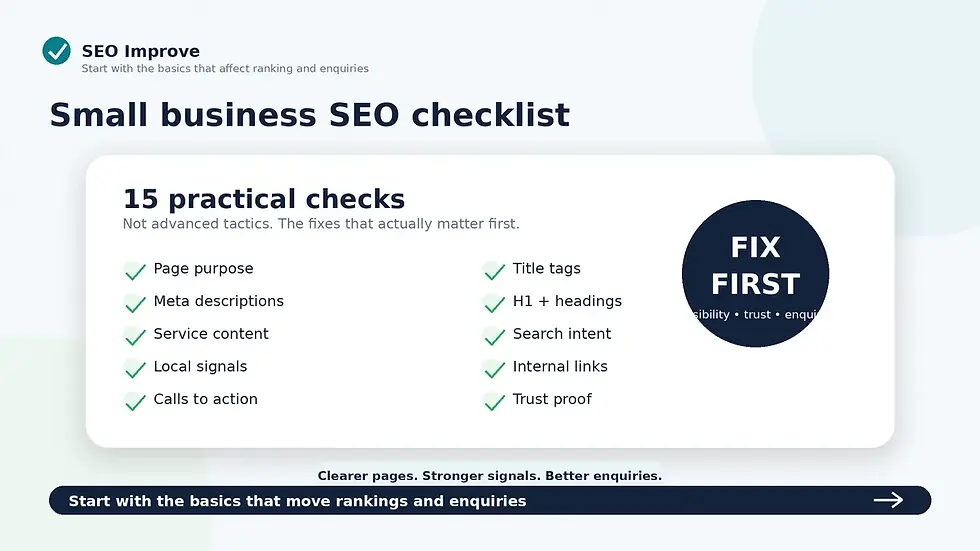
You can also use our small business SEO checklist to identify the basic areas that deserve attention before committing to wider SEO work.
What is the difference between a website audit and an SEO review?
The main difference is focus.
A website audit checks the overall condition of the website.
An SEO review checks whether the website is likely to be found, understood, trusted, and used by people searching for your services.
A website audit may tell you your site has design, speed, navigation, or usability issues.
An SEO review should tell you whether your pages are targeting the right searches, whether the content is strong enough, whether Google has enough context, and whether visitors are being given a clear reason to contact you.
Here is the simple difference:
Question | Website audit | SEO review |
Is the website generally healthy? | Yes | Sometimes |
Is the website easy to use? | Yes | Sometimes |
Are there design or layout issues? | Yes | Sometimes |
Can Google understand the pages? | Sometimes | Yes |
Are page titles and meta descriptions strong? | Sometimes | Yes |
Does the content match search intent? | Sometimes | Yes |
Are local SEO signals clear? | Sometimes | Yes |
Are trust signals strong enough? | Sometimes | Yes |
Are calls to action helping enquiries? | Sometimes | Yes |
Does it prioritise SEO fixes? | Not always | Yes |
Both can be useful. But they solve slightly different problems.
Which one does my small business need?
Your small business probably needs a website audit if:
The website looks outdated
The layout is confusing
The site is slow or technically unreliable
Visitors struggle to find key information
The mobile version is poor
You are considering a redesign
The site has obvious usability problems
If a redesign is already planned, do not assume the existing URLs are disposable simply because the visual website is changing. See whether you should keep the same URLs when redesigning your website before the new structure is finalised.
Your small business probably needs an SEO review if:
Your website is live but not showing well on Google
Competitors appear above you in search results
You are unsure what keywords your pages should target
Your page titles and meta descriptions are weak or generic
Your service pages are thin or unclear
You serve a local area but your local SEO signals are weak
You get some visitors but very few enquiries
You are thinking about paying for SEO but do not know what needs fixing first
For many small businesses, an SEO review is the smarter first step because it focuses on commercial performance.
It does not just ask whether the website exists. It asks whether the website is doing its job.
Can an automated audit replace an SEO review?
No. An automated audit can be useful, but it cannot replace the judgement shown in a proper, manually prepared SEO review report.
Automated tools can spot some technical issues. They may flag missing meta descriptions, broken links, page speed warnings, image problems, or basic SEO errors.
That can help, but it is only part of the picture.
An automated tool cannot properly judge whether your page is persuasive, whether your service wording is clear, whether your local relevance is strong enough, whether visitors trust you, or whether your calls to action are likely to generate enquiries.
It also cannot understand your business in the same way a manual review can.
For example, a tool may say your page has a title tag. That does not mean the title tag is any good.
A tool may say your page has headings. That does not mean the headings match what customers are searching for.
A tool may say your page has enough words. That does not mean the content answers the right questions or builds enough trust.
That is the problem with relying only on automated checks. They can tell you something is present. They cannot always tell you whether it is effective.
We explore this further in what automated audits and manual SEO reviews each miss.
Should I audit my website before paying for SEO?
Yes — but the type of review matters.
Before paying for monthly SEO, ads, a redesign, or new content, you should understand what is currently holding the website back.
If the redesign also involves moving to Wix, WordPress, Shopify or another CMS, the migration itself needs planning. See Does Changing Website Platform Affect SEO? for the URLs, redirects, content and indexing signals that should be checked before the existing site is replaced.
If the platform is staying the same but the website itself is being redesigned, also decide which existing URLs should be preserved during the redesign before pages are renamed or replaced.
Otherwise, you risk spending money in the wrong place.
If Google Ads is the investment you are considering, our guide Should You Fix Your Website Before Paying for Google Ads? explains which website weaknesses can waste paid traffic and which issues can reasonably wait.
For example:
If your page titles are weak, new blog posts may not fix the problem.
If your service pages are thin, more traffic may not convert.
If your local signals are unclear, you may struggle to rank for local searches.
If your calls to action are vague, visitors may leave without enquiring.
If your trust signals are weak, people may choose a competitor even after finding you.
A focused SEO review gives you a clear starting point. It helps you avoid guessing.
Instead of asking, “Should I spend more on SEO?” you can ask, “What exactly needs fixing first?”
That is a much better question.
What does an SEO review include?
A useful SEO review should include more than a technical checklist.
For a small business website, what an SEO review usually checks:
Search visibility
Can the important pages be found and understood by search engines? Are there obvious indexing, structure, or discoverability issues?
Page titles and meta descriptions
Do the title tags and meta descriptions clearly explain the page, include the right search terms, and encourage people to click?
Heading structure
Does each page have a clear main heading? Are the supporting headings logical, useful, and easy to scan?
Search intent
Does the page answer what the customer is actually looking for, or does it talk around the subject without giving enough useful information?
Content quality
Is the content clear, specific, and helpful? Does it explain the service properly? Does it avoid vague claims and thin wording?
Local SEO signals
If the business serves a local area, are the locations, service areas, and local relevance clear enough?
Internal links
Do the pages link to each other in a way that helps visitors and search engines understand the site?
Trust signals
Does the website give people enough reason to trust the business? This may include reviews, examples, experience, guarantees, process explanations, FAQs, or visible contact details.
Calls to action
Is it obvious what the visitor should do next? Are the buttons and contact routes clear?
Conversion barriers
Is anything making it harder for visitors to enquire, such as vague wording, weak contact options, hidden prices, unclear next steps, or lack of reassurance?
Priority actions
Most importantly, the review should tell you what to fix first.
A long list of problems is not enough. You need priorities.
Why an SEO review is often better for small businesses
Most small business websites do not fail because of one tiny technical error.
They usually struggle because the message is unclear, the pages are too thin, the search terms are poorly targeted, the local signals are weak, or visitors are not given enough confidence to enquire.
That is why a focused SEO review is often more useful than a broad website audit.
It looks at the website from the perspective of search engines and potential customers.
Can the page be found?
Can it be understood?
Can it be trusted?
Can it turn interest into action?
Those are the questions that matter if the website is supposed to generate enquiries.
When a website audit may still be the right option
A website audit may be the better option if your website has wider problems beyond SEO.
For example, you may need a broader audit if:
The website is very old
The design looks unprofessional
The site is difficult to navigate
The mobile version is poor
The pages load slowly
The structure is confusing
You are planning a full redesign
You suspect major technical problems
In those cases, SEO may only be one part of the issue.
But if the website is already live, reasonably functional, and mainly struggling with Google visibility or enquiries, an SEO review is usually the more direct starting point.
The simple decision
Choose a website audit if you need to understand the overall condition of your site.
Choose an SEO review if you need to understand why your site is not being found, trusted, or turned into enquiries.
For most small businesses, the best first step is not a huge technical project.
It is a clear, practical review that shows what is working, what is holding the website back, and what should be fixed first.
Want to know what your website needs?
If your website is live but not performing, an SEO Improve review can help you understand what is holding it back.
We check your website manually and look at the areas that matter most for small business visibility, trust, and enquiries.
You will receive practical findings, clear priorities, and plain-English recommendations you can act on.
Request an SEO Review and find out what needs fixing before you spend more money on SEO, ads, or a redesign.