Should Your Google Business Profile Link to Your Homepage or a Service Page?
Updated: Sep 11
If you are wondering should Google Business Profile link to homepage or service page, the best answer for most small businesses is:
Your main Google Business Profile website link should usually point to the page that best represents the business shown in the profile.
For a typical single-location small business, that will normally be the homepage.
But there are exceptions.
A dedicated location page may be better for a business with several physical locations.
A service page can sometimes be an appropriate destination when the profile and page genuinely represent the same specific offer.
And separate Google Business Profile posts, booking links or other supported action links can often point directly to the relevant service or conversion page.
The wrong approach is:
service page contains more keywords → therefore link Google Business Profile to service page
That is too simplistic.
Think about the relationship between:
Google Business Profile
↓
the business it represents
↓
the page somebody should logically land on
If you are reviewing your wider local setup, start with our guide to local SEO for small businesses.
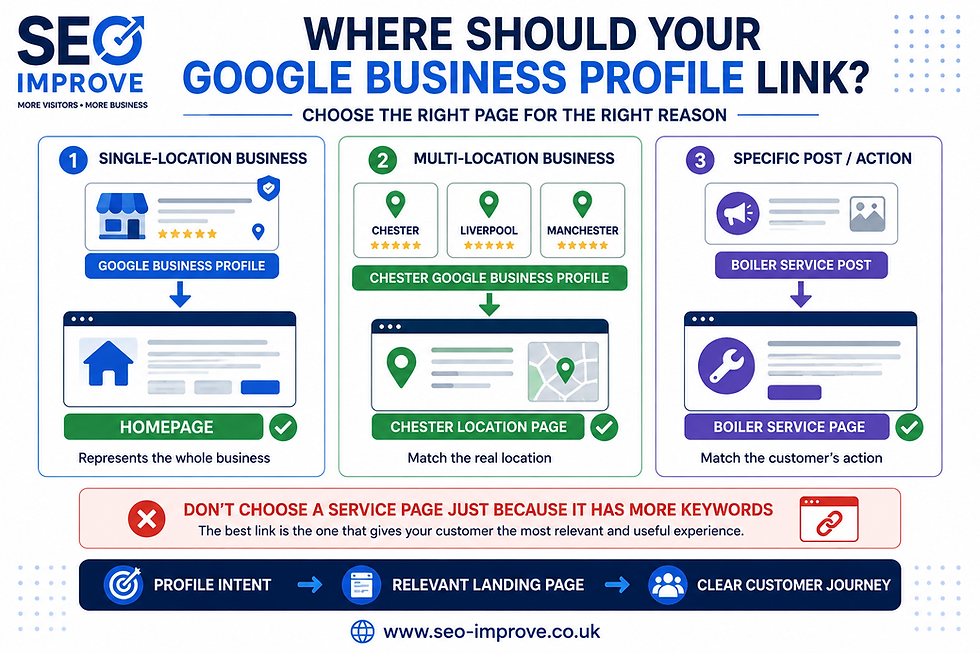
Should Google Business Profile Link to Homepage or Service Page?
For most single-location small businesses offering several services, I would normally use the homepage as the main Website link.
Imagine:
Smith Heating
offers:
boiler repair
boiler servicing
boiler installation
emergency plumbing
Its Google Business Profile represents:
Smith Heating
not:
Smith Heating Boiler Repair Department
The homepage should therefore provide a useful overall introduction to:
the business
its main services
its location or service area
trust signals
important service pages
contact options
Then customers can move from the homepage into the service that interests them.
A sensible structure is:
Google Business Profile
↓
Homepage
↓
Boiler Repair
Boiler Servicing
Boiler Installation
Emergency Plumbing
That is usually clearer than pointing the entire Business Profile towards one individual service.
Why Is the Homepage Usually the Best Default?
Your Google Business Profile normally represents the business as a whole.
Your homepage should do the same.
A strong homepage answers:
Who are you?
What do you do?
Where do you work?
Why should I trust you?
Which service do I need?
What should I do next?
That makes it a natural landing page for somebody who has discovered the company through Google Maps or a local search result.
The homepage can then link prominently to each important service.
This also helps preserve clear page roles:
Homepage = business overview
Service page = detailed information about one specific service
If your website currently blurs those roles, see why your homepage may be ranking instead of your service page.
Does Linking Google Business Profile to a Service Page Improve Rankings?
Do not assume it does.
There is no simple Google rule saying:
Link your Business Profile to your most optimised service page and it will rank better.
Changing the Website link should not be treated as a local SEO shortcut.
The landing page matters because it affects:
relevance
customer experience
consistency
conversion
how clearly the website represents the business
But that is different from saying:
service-page URL = ranking boost
If your Boiler Repair page is struggling to rank, changing the Google Business Profile Website link from your homepage to that page does not fix:
weak service-page content
vague titles
poor headings
weak internal links
unclear location information
weak trust signals
competing pages
Those issues still need fixing.
What If One Service Is Much More Important Than Everything Else?
This is where the decision becomes less obvious.
Imagine a business technically provides several services but 90% of its customers want:
Emergency Boiler Repair
The owner might think:
Why not send everybody from Google straight to the Boiler Repair page?
That can sometimes make commercial sense if:
the Business Profile strongly represents that specific service
the page accurately represents the business
visitors landing there can still understand who the company is
the page clearly covers the relevant location
the page provides routes to other important services
the page gives a better experience than the homepage
But before doing that, ask another question:
Why is the homepage not good enough?
If your homepage fails to clearly explain your main service, the better long-term answer may be to improve the homepage.
Do not use a deep service page simply to hide a weak homepage.
What If Your Business Only Has One Main Service?
Then the distinction can become very small.
Imagine a specialist company that provides only:
Drain Surveys
Its homepage is essentially a detailed Drain Survey landing page.
In that situation:
Homepage
and:
main service page
may perform almost the same role.
You may not even need a separate service URL.
This is why website architecture should be decided before choosing the Google Business Profile destination.
Our guide to whether every service should have its own page explains when a separate service URL genuinely adds value.
What Should a Good Homepage Linked From Google Business Profile Contain?
If the homepage is your Business Profile destination, it needs to do its job properly.
I would expect a local service-business homepage to make the following clear quickly.
Business proposition
What does the business actually do?
Primary services
What are the main services customers can choose?
Location
Where is the business based or what areas does it genuinely serve?
Trust
Why should somebody choose this company?
Useful evidence might include:
reviews
qualifications
accreditations
experience
real examples of work
guarantees where appropriate
Navigation to important services
Do not make somebody hunt through the menu.
If Boiler Repair is an important service, provide an obvious route to the Boiler Repair page.
Contact options
Phone, enquiry form, booking or another appropriate next step should be easy to find.
The homepage does not need to explain every service in full.
Its job is to establish the business and guide the customer towards the right next page.
When Should Google Business Profile Link to a Location Page?
This is one of the clearest exceptions to the homepage rule.
Imagine a plumbing company has genuine offices in:
Chester
Liverpool
and:
Manchester
and each location has its own eligible Google Business Profile.
Linking all three profiles to:
is possible, but individual location landing pages may provide a much more useful customer experience.
For example:
Chester Google Business Profile
↓
/chester
Liverpool Google Business Profile
↓
/liverpool
Manchester Google Business Profile
↓
/manchester
Each location page can explain:
the actual location
services available there
opening hours
contact details
relevant team
local reviews
service area
directions or practical information
That creates a much tighter relationship between:
profile
and:
landing page.
Do not create fake location pages or fake Google Business Profiles simply to reproduce this structure.
The locations need to represent real eligible businesses.
What About a Service-Area Business With No Public Shop?
The same principle still applies.
Imagine a plumber based at home who travels to customers around Chester.
The Google Business Profile represents the plumbing business.
Its homepage might say:
Plumbing and heating services across Chester, Frodsham, Helsby and surrounding areas.
That makes the homepage a perfectly sensible Website destination.
You do not need:
/plumber-chester
purely because the Business Profile mainly appears for Chester searches.
The website needs to represent the real business.
It does not need to mirror every possible local keyword.
Should You Link Google Business Profile to a Location-Service Page?
Be careful here.
Imagine you have:
/boiler-repair-chester
and the Google Business Profile represents a heating company in Chester.
You might be tempted to use that URL because it contains:
boiler repair
and:
Chester
But ask:
Does that page represent the whole business shown in the profile?
If the company also offers:
servicing
installations
plumbing
bathrooms
then a Boiler Repair Chester page may be too narrow.
Someone clicking:
Website
on the Business Profile could reasonably expect to reach the business website, not one specific service.
A location-specific homepage or broad location landing page is normally more logical where several services exist.
Don't Create a Separate Google Business Profile for Every Service
This is an important distinction.
Your website can legitimately have:
Boiler Repair
Boiler Servicing
Boiler Installation
Emergency Plumbing
pages.
That does not mean you should create:
Smith Heating Boiler Repair
Smith Heating Boiler Servicing
Smith Heating Boiler Installation
as separate Google Business Profiles operating from the same business simply to target individual keywords.
Google Business Profile should represent real eligible businesses.
Do not restructure the profile around keywords.
Your website is where individual services can be separated in detail.
What About Google Business Profile Service and Action Links?
The main Website link is not the only way a visitor can move from Google to your site.
Depending on the business category and features available to the profile, Google can support other business or action links such as:
booking
reservations
ordering
service information
other direct actions
Those links should normally take the visitor to the page where they can complete the relevant action.
For example:
Website
↓
Homepage
but:
Book Appointment
↓
Booking page
or:
View Services
↓
Relevant services page
This is much better than trying to make one Website URL perform every job.
The same principle applies to Google Business Profile posts.
If you publish a post specifically about:
Boiler Servicing
the post's action link can reasonably point directly to:
Boiler Servicing
rather than making somebody return to the homepage and find the service again.
What Should Google Business Profile Posts Link To?
Usually the page most relevant to the individual post.
For example:
GBP post
Annual Boiler Servicing Available in Chester
Best destination:
Boiler Servicing page
not:
Homepage.
GBP post
New Office Opening Hours
Best destination:
Possibly the relevant location or contact page.
GBP post
New SEO Review Service
Best destination:
The SEO Review service page.
This distinction matters.
Your primary Website button and your individual content/action links do not all need to point to the same URL.
Think about what the customer is trying to do.
Should Google Business Profile Link Directly to Your Contact Page?
Usually not as the primary Website link.
A contact page is typically too narrow to represent the whole business.
Someone clicking:
Website
may want to:
understand the service
compare options
check pricing
read reviews
investigate credibility
see whether you cover their location
Dropping them immediately onto:
Name
Message
does not answer those questions.
Google Business Profile already provides direct routes such as calls and directions where applicable.
Use the website link to provide useful information before forcing an enquiry.
What If Your Homepage Has Very Little Useful Content?
Fix it.
Do not treat Google Business Profile linking as a workaround.
Suppose your homepage contains:
Welcome to Smith Heating
We provide a professional service. Contact us today.
while your Boiler Repair page contains:
detailed service information
coverage
reviews
pricing
FAQs
strong calls to action
The Boiler Repair page may be a better page.
But the bigger problem is obvious:
your homepage is weak.
Improve it so it becomes a useful business overview.
If Google itself is already choosing the homepage for searches where you want a dedicated service page to rank, read why Google may choose your homepage instead of your service page.
Your Website Link Should Match the Business Profile
Whichever URL you choose, the relationship should make sense.
Imagine the profile says:
Smith Heating
Category:
Heating contractor
Location:
Chester
Services:
boiler repair
boiler servicing
boiler installation
But the linked landing page says:
Bathroom Renovations in Liverpool
Something is clearly wrong.
A good landing page should reinforce the same basic business information.
That includes:
business identity
primary services
genuine location or service area
contact details
appropriate branding
Your website and Google Business Profile should feel like two parts of the same business.
Not separate SEO campaigns.
Should the Google Business Profile Website Link Contain Tracking Parameters?
It can be useful to track traffic from the profile separately in analytics.
For example, you might use a tagged URL so you can distinguish visitors coming from your Google Business Profile from other organic visits.
A common structure is:
?utm_source=google&utm_medium=organic&utm_campaign=gbp
This can help you measure:
website visits from the profile
enquiries
conversions
behaviour after the click
Do not change the landing page purely because one URL appears easier to track.
Choose the correct destination first.
Then track it.
How Can You Tell Whether the Current GBP Landing Page Is Working?
Do not judge it only by rankings.
Look at what happens after the click.
Ask:
Is traffic reaching the correct page?
Check your analytics.
Do visitors immediately leave?
That could suggest the page does not match what they expected.
Do visitors move into relevant services?
A homepage should help them do this easily.
Do they enquire?
Track meaningful conversions.
Do customers repeatedly ask questions the page should answer?
The landing page may lack useful information.
Is the profile attracting one particular service disproportionately?
That might justify stronger prominence for that service on the homepage or a more specific link from individual GBP posts.
Use customer behaviour to improve the journey.
What If My Business Ranks by Name but Not for Its Services?
Do not assume changing the Google Business Profile website destination will solve this.
If searching:
Smith Heating
works
but:
boiler repair Chester
does not
the problem is more likely to involve the strength and relevance of your service pages and wider local signals.
You may need to review:
service-page structure
titles
headings
internal links
location relevance
content depth
reviews and trust evidence
competition
Our guide to why a website can rank for its business name but not its services explains that problem in detail.
Should You Change the GBP Link to the Service Page You Want to Rank?
Not simply for that reason.
Suppose you want:
Boiler Repair
to rank better.
Changing:
Google Business Profile → Homepage
into:
Google Business Profile → Boiler Repair
because you hope the service page will receive more SEO value is not the strategy I would start with.
Instead ask:
Is Boiler Repair a strong page?
Does the title clearly describe the service?
Does the H1 reinforce it?
Is the location clear?
Do related pages link to it?
Does the homepage link prominently to it?
Does the page answer customer questions?
Does it contain useful trust evidence?
Is another page competing with it?
Those are more fundamental issues.
A strong website should make the relationship between homepage and service pages clear internally.
Homepage vs Service Page: A Simple Decision Test
Use this checklist.
Use the homepage when:
one Google Business Profile represents the whole business
the business provides several important services
the homepage clearly explains the overall offer
customers need to choose between services
the homepage provides good trust and contact information
it accurately represents the profile's location or service area
For many small businesses, this is the correct answer.
Consider a specific location page when:
the business genuinely operates several eligible locations
each location has its own Google Business Profile
the location page accurately represents that specific branch
contact details and service information are location-specific
Consider a service page only when:
the profile genuinely represents that narrow service proposition
the page accurately represents the business shown in the profile
the page provides the best experience for most people clicking Website
the choice is based on customer usefulness rather than keyword targeting
Use action or post links when:
somebody is being invited to book
somebody wants one particular service
the post promotes one specific offer
the visitor should complete a specific action
Different links can perform different jobs.
A Practical Example
Imagine:
Jones Electrical
Based in Warrington.
Services:
emergency electrician
rewiring
EV charger installation
electrical inspections
Main Google Business Profile Website link
Homepage
because the profile represents Jones Electrical as a whole.
Google Business Profile post
Need an Emergency Electrician Tonight?
Link:
Emergency Electrician service page
Google Business Profile post
Home EV Charger Installation
Link:
EV Charger Installation service page
Booking action
Link:
Booking or enquiry page
Second genuine office in Chester
Chester Google Business Profile:
Chester location page
This structure follows the customer's intent rather than trying to force every click through the same URL.
The Mistake to Avoid: Treating the GBP Link Like Anchor Text
Do not think:
I want the Boiler Repair page to rank for boiler repair, therefore Google Business Profile must link to Boiler Repair.
That confuses two different decisions.
Your Business Profile website link is primarily a customer destination.
Your website's own internal-link structure is where you can clearly reinforce which pages belong to individual services.
For example:
Homepage
↓
Boiler Repair
and supporting articles can also point towards Boiler Repair.
That creates a clear architecture without making the Google Business Profile Website button do all the work.
Make Sure the Linked Page Actually Works
Whatever destination you choose, test it.
Check:
correct HTTPS URL
no broken page
no accidental redirect loop
mobile usability
reasonable load speed
correct business information
visible contact options
clear service information
correct location details
A theoretically perfect landing-page strategy is useless if the link returns an error or gives mobile visitors a poor experience.
Don't Keep Changing the GBP Website Link
Another mistake is constant tinkering.
Week 1:
Homepage.
Week 2:
Service page.
Week 3:
Location page.
Week 4:
Homepage again.
Then the owner asks:
Which one improved rankings?
That is almost impossible to answer because multiple other factors may have changed at the same time.
Choose the page that makes the most structural and commercial sense.
Make sure it is strong.
Then concentrate on improving the website and profile rather than repeatedly changing the URL.
Should Your Google Business Profile Link to Your Homepage or a Service Page? The Bottom Line
For most single-location small businesses with several services:
Google Business Profile
↓
Homepage
is the best default.
The homepage represents the business.
It should explain:
what you do
where you work
which services matter
why customers should trust you
where they should go next
Then use your website's internal links to guide customers into individual service pages.
For genuine multi-location businesses:
individual Google Business Profile
↓
matching location page
can make more sense.
For specific offers and actions:
GBP post / booking / supported action link
↓
relevant service or conversion page
is often the better journey.
Do not change your main Website link to a service page simply because the URL contains more keywords.
The better question is:
Which page most accurately represents the business shown in this profile and gives the person clicking it the most useful next step?
If your Google Business Profile, website and service pages do not currently tell the same clear story, our Local SEO Review checks them together alongside reviews, service areas and relevant local competitors. You receive a prioritised action plan showing which local-search problems are actually worth fixing first.”
Our small business SEO review looks at local signals, service-page structure, homepage positioning, internal links, search intent and conversion together.
Request an SEO review and we will show you which changes are actually worth prioritising.
Frequently Asked Questions
Should Google Business Profile link to homepage or service page?
For most single-location businesses offering several services, the homepage is usually the most logical main Website destination because the Business Profile represents the whole business. Use more specific pages where the profile, location or action genuinely calls for them.
Does linking Google Business Profile to a service page improve SEO?
Do not assume that changing the Website link to a keyword-focused service page provides a ranking boost. Choose the destination based on relevance, accuracy and customer experience.
Should a multi-location business link every Google Business Profile to the homepage?
A dedicated landing page for the specific location can often provide a better experience because the page can contain the correct address, contact details, services and local information for that branch.
Can Google Business Profile posts link to service pages?
Yes, where the post relates directly to that service and the page is the logical destination. A post about boiler servicing, for example, can sensibly link directly to the Boiler Servicing page.
Should Google Business Profile link to the contact page?
Usually not as the primary Website destination. Customers clicking Website may still want to understand the business, services, pricing, trust evidence and coverage before enquiring.
What if my service page is stronger than my homepage?
Improve the homepage rather than automatically using the service page as a workaround. The homepage should be a useful representation of the business if it is the natural Google Business Profile destination.
Should a service-area business link Google Business Profile to its homepage?
Usually, yes, where one profile represents the overall business and the homepage clearly explains its services and genuine service area.
Can I track Google Business Profile website clicks?
Yes. Analytics tracking parameters can help distinguish website visits originating from your Business Profile, allowing you to measure what those visitors do after arriving.
Should I create separate Google Business Profiles for each service?
No, not simply to target individual service keywords. Google Business Profiles should represent real eligible businesses. Use individual website service pages to explain separate services.


